Have you finished reading the Large Catechism with me? Great.
Now, do it again!
Or pass it along to a friend.
Did you get completely behind and lose all focus? Great.
Catch up!
Or pass it along to do with a friend.
The point is, just read the Large Catechism, and encourage others to join you!
I promise it will be well worth your time.
Here are the links to the entire series:
Invitation
Introduction, Part 1
Introduction, Part 2
Introduction, Part 3
Short Preface, Part 1
Short Preface, Part 2
Short Preface, Part 3
The First Commandment, Part 1
The First Commandment, Part 2
The First Commandment, Part 3
The First Commandment, Part 4
The First Commandment, Part 5
The Second Commandment, Part 1
The Second Commandment, Part 2
The Second Commandment, Part 3
The Third Commandment, Part 1
The Third Commandment, Part 2
The Third Commandment, Part 3
The Fourth Commandment, Part 1
The Fourth Commandment, Part 2
The Fourth Commandment, Part 3
The Fourth Commandment, Part 4
The Fourth Commandment, Part 5
The Fourth Commandment, Part 6
The Fourth Commandment, Part 7
The Fifth Commandment, Part 1
The Fifth Commandment, Part 2
The Sixth Commandment, Part 1
The Sixth Commandment, Part 2
The Seventh Commandment, Part 1
The Seventh Commandment, Part 2
The Seventh Commandment, Part 3
The Eighth Commandment, Part 1
The Eighth Commandment, Part 2
The Eighth Commandment, Part 3
The Eighth Commandment, Part 4
The Ninth and Tenth Commandments, Part 1
The Ninth and Tenth Commandments, Part 2
Conclusion of the Ten Commandments. Part 1
Conclusion of the Ten Commandments. Part 2
Conclusion of the Ten Commandments. Part 3
The Apostles' Creed Introduction
The Apostles' Creed Article 1
The Apostles' Creed Article 2
The Apostles' Creed Article 3, Part 1
The Apostles' Creed Article 3, Part 2
The Apostles' Creed Article 3, Part 3
The Apostles' Creed Article 3, Part 4
The Lord's Prayer Introduction, Part 1
The Lord's Prayer Introduction, Part 2
The Lord's Prayer Introduction, Part 3
The Lord's Prayer, First Petition
The Lord's Prayer, Second Petition
The Lord's Prayer, Third Petition
The Lord's Prayer, Fourth Petition
The Lord's Prayer, Fifth Petition
The Lord's Prayer, Sixth Petition
The Lord's Prayer, Seventh Petition
Holy Baptism, Part 1
Holy Baptism, Part 2
Holy Baptism, Part 3
Holy Baptism, Part 4
Holy Baptism, Of Infant Baptism, Part 1
Holy Baptism, Of Infant Baptism, Part 2
Holy Baptism, Of Infant Baptism, Part 3
The Sacrament of the Altar, Introduction
The Sacrament of the Altar, Part 1
The Sacrament of the Altar, Part 2
The Sacrament of the Altar, Part 3
The Sacrament of the Altar, Part 4
The Sacrament of the Altar, Part 5
The Sacrament of the Altar, Part 6
The Sacrament of the Altar, Part 7
Showing posts with label Large Catechism. Show all posts
Showing posts with label Large Catechism. Show all posts
Friday, December 5, 2014
Thursday, December 4, 2014
Large Catechism: The Sacrament of the Altar, Part 7
Read the Large Catechism with me.
Ten-minute studies on short readings from the Large Catechism.
Let's do this.
Click on the link below and read the short assigned reading. Then, if you have time, check out what I have to say about it. If not, no problem. Just soak up the goodness of the LC.
The Sacrament of the Altar, Part 7: Click here and read 75-87.
The basics:
- If we do not feel hunger or thirst for the Sacrament, we need to remember that we are made of flesh. St. Paul tells us in Galations 5 that the fruit of the flesh are these: adultery, fornication, uncleanness, lasciviousness, idolatry, witchcraft, hatred, variance, emulations, wrath, strife, seditions, heresies, envyings, murders, drunkenness, revelings, and such like. Run to the Sacrament because of your flesh!
- If you are unable to feel your own sinful flesh, at least believe the Scriptures; they will not lie to you, and they know your flesh better than you yourself.
- The less you feel your sins and infirmities, the more reason you have to go to the Sacrament to seek help and a remedy.
- If you are in the world, there will be sins and misery. Others will do things to give you cause for sin.
- The devil leads the heart astray from the Word of God, and blinds it, that we cannot feel our distress or come to Christ.
- If after seeing the impact of your flesh, the world, and the devil, you still do not hunger and thirst for the Sacrament, ask others to pray that the stone be removed from your heart. And come to the Sacrament more eagerly, as to fight off the flesh, the world, and the devil which are deceiving you.
- This exhortation of the faith is for the old and grown and the young, who ought to be brought up in the Christian doctrine and understanding. They need to practice this from their youth and accustom themselves to them.
- It is the father of the family's duty, by the command of God, to teach these things to his children.
My thoughts today:
That's all he wrote, my friends.
Ha!
Along with about 6 million other things - all about as awesome as the next.
Don't let this be the last Luther you read. Don't let this be the last foundational Lutheran document you read. Like I said when we started this journey 15 weeks ago, there is just so much really bad theology out there for you to read. You must fill yourself with good stuff.
It will make you change the way you respond to daily struggles.
It will make you capable of fighting off incorrect doctrine.
It will force you to see yourself as a poor, miserable sinner, in need of real forgiveness.
It will pour the Gospel out on you in ways you have never experienced.
The Lord, in His infinite wisdom, has given us the good stuff.
Soak it up, friends.
I'm out.
Ten-minute studies on short readings from the Large Catechism.
Let's do this.
Click on the link below and read the short assigned reading. Then, if you have time, check out what I have to say about it. If not, no problem. Just soak up the goodness of the LC.
The Sacrament of the Altar, Part 7: Click here and read 75-87.
The basics:
- If we do not feel hunger or thirst for the Sacrament, we need to remember that we are made of flesh. St. Paul tells us in Galations 5 that the fruit of the flesh are these: adultery, fornication, uncleanness, lasciviousness, idolatry, witchcraft, hatred, variance, emulations, wrath, strife, seditions, heresies, envyings, murders, drunkenness, revelings, and such like. Run to the Sacrament because of your flesh!
- If you are unable to feel your own sinful flesh, at least believe the Scriptures; they will not lie to you, and they know your flesh better than you yourself.
- The less you feel your sins and infirmities, the more reason you have to go to the Sacrament to seek help and a remedy.
- If you are in the world, there will be sins and misery. Others will do things to give you cause for sin.
- The devil leads the heart astray from the Word of God, and blinds it, that we cannot feel our distress or come to Christ.
- If after seeing the impact of your flesh, the world, and the devil, you still do not hunger and thirst for the Sacrament, ask others to pray that the stone be removed from your heart. And come to the Sacrament more eagerly, as to fight off the flesh, the world, and the devil which are deceiving you.
- This exhortation of the faith is for the old and grown and the young, who ought to be brought up in the Christian doctrine and understanding. They need to practice this from their youth and accustom themselves to them.
- It is the father of the family's duty, by the command of God, to teach these things to his children.
My thoughts today:
That's all he wrote, my friends.
Ha!
Along with about 6 million other things - all about as awesome as the next.
Don't let this be the last Luther you read. Don't let this be the last foundational Lutheran document you read. Like I said when we started this journey 15 weeks ago, there is just so much really bad theology out there for you to read. You must fill yourself with good stuff.
It will make you change the way you respond to daily struggles.
It will make you capable of fighting off incorrect doctrine.
It will force you to see yourself as a poor, miserable sinner, in need of real forgiveness.
It will pour the Gospel out on you in ways you have never experienced.
The Lord, in His infinite wisdom, has given us the good stuff.
Soak it up, friends.
I'm out.

Large Catechism: The Sacrament of the Altar, Part 6
Read the Large Catechism with me.
Ten-minute studies on short readings from the Large Catechism.
Let's do this.
Click on the link below and read the short assigned reading. Then, if you have time, check out what I have to say about it. If not, no problem. Just soak up the goodness of the LC.
The Sacrament of the Altar, Part 6: Click here and read 64-74.
The basics:
- The promise attached to the Sacrament: "This is My body, given for you. This is My blood, shed for you, for the remission of sins."
- In this Sacrament He offers to us the entire treasure which He has brought for us from heaven.
- Luther compares this promise to what our Lord says in Matthew 11:28 - Come unto Me, all ye that labor and are heavy laden, and I will give you rest.
- We must never flee from the Sacrament, but view it as a pure, wholesome, comforting remedy giving salvation and comfort, which will cure us and give us life in soul and body.
- Those who despise it and live in and unchristian manner receive it to their hurt and damnation, just as a sick person who eats and drinks what is forbidden him by the doctor.
- In the Sacrament we receive from the lips of Christ forgiveness of sin, which brings with it the grace of God and the Spirit with all His gifts, protection, shelter, and power against death and the devil and all misfortune.
- Christ Himself says: They that be whole, need not a physician, but they that be sick. Those who are weary and heavy-laden with their sins, with the fear of death, and temptations of the flesh and of the devil are those who need the great Physician and His body and blood.
- If we would wait until we are rid of our burdens to receive Communion, that we might come pure and holy, we must forever stay away. If we are pure and holy in ourselves, then we have no need of Christ.
My thoughts today:
"If, therefore, you are heavy-laden and feel your weakness, then go joyfully to this Sacrament and obtain refreshment, consolation, and strength."
"For where the soul has recovered, the body also is relieved."
"If you are pure and godly, you have no need of Me, and I, in turn, none of thee."
Pretty good stuff right there, folks.
This Sacrament is for us, friends...
The weary.
The unworthy.
The sinners.
The weak.
The heavy-laden.
The dying.
May we always know where refreshment, consolation, strength. forgiveness, life, and salvation are given.
Ten-minute studies on short readings from the Large Catechism.
Let's do this.
Click on the link below and read the short assigned reading. Then, if you have time, check out what I have to say about it. If not, no problem. Just soak up the goodness of the LC.
The Sacrament of the Altar, Part 6: Click here and read 64-74.
The basics:
- The promise attached to the Sacrament: "This is My body, given for you. This is My blood, shed for you, for the remission of sins."
- In this Sacrament He offers to us the entire treasure which He has brought for us from heaven.
- Luther compares this promise to what our Lord says in Matthew 11:28 - Come unto Me, all ye that labor and are heavy laden, and I will give you rest.
- We must never flee from the Sacrament, but view it as a pure, wholesome, comforting remedy giving salvation and comfort, which will cure us and give us life in soul and body.
- Those who despise it and live in and unchristian manner receive it to their hurt and damnation, just as a sick person who eats and drinks what is forbidden him by the doctor.
- In the Sacrament we receive from the lips of Christ forgiveness of sin, which brings with it the grace of God and the Spirit with all His gifts, protection, shelter, and power against death and the devil and all misfortune.
- Christ Himself says: They that be whole, need not a physician, but they that be sick. Those who are weary and heavy-laden with their sins, with the fear of death, and temptations of the flesh and of the devil are those who need the great Physician and His body and blood.
- If we would wait until we are rid of our burdens to receive Communion, that we might come pure and holy, we must forever stay away. If we are pure and holy in ourselves, then we have no need of Christ.
My thoughts today:
"If, therefore, you are heavy-laden and feel your weakness, then go joyfully to this Sacrament and obtain refreshment, consolation, and strength."
"For where the soul has recovered, the body also is relieved."
"If you are pure and godly, you have no need of Me, and I, in turn, none of thee."
Pretty good stuff right there, folks.
This Sacrament is for us, friends...
The weary.
The unworthy.
The sinners.
The weak.
The heavy-laden.
The dying.
May we always know where refreshment, consolation, strength. forgiveness, life, and salvation are given.
Wednesday, December 3, 2014
Large Catechism: The Sacrament of the Altar, Part 5
Read the Large Catechism with me.
Ten-minute studies on short readings from the Large Catechism.
Let's do this.
Click on the link below and read the short assigned reading. Then, if you have time, check out what I have to say about it. If not, no problem. Just soak up the goodness of the LC.
The Sacrament of the Altar, Part 5: Click here and read 55-63.
The basics:
- Luther uses this section to answer this question: How can I come to the Sacrament if I do not feel prepared?
- Luther describes his own struggle with attempting to be so holy that he was thrown down to despair feeling unworthy for the Sacrament.
- The more you feel your unworthiness for the Sacrament and use it as an excuse to stay away from it, the more you will continue to feel unworthy.
- By contrast, if you regard how good and pure you are, you do not need the forgiveness of sins offered in the Sacrament. Therefore, you must not approach.
- Those who do not desire forgiveness and do not wish to be godly should be told to stay away from the Sacrament. They are not prepared to receive forgiveness of sins.
- Those who desire to be godly, even though they are full of sin, must not stay away. They are prepared to receive the forgiveness of sins.
- The Sacrament does not depend on our worthiness. We are not baptized because we are worthy and holy, nor do we go to confession because we are pure and without sin. We are poor miserable sinners, and just because we are unworthy, we do these things.
- We are to say, "I, indeed, would like to be worthy; but I come, not upon any worthiness, but upon Thy Word, because Thou hast commanded it, as one who would gladly be Thy disciple, no matter what becomes of my worthiness."
- We look more upon ourselves than upon the Word and lips of Christ. It is our nature to act that we can stand and rest firmly on ourselves.
My thoughts today:
May we all be thankful the Sacrament does not depend upon our worthiness. Phew. We would be in a sorry state of despair if such was the case.
Sometimes it is best to just let the words of the Large Catechism sink in a little more. So, here are the words I want us to really consider today -
"...he ought not stay away from the Sacrament, lest he may deprive himself of life."
"...it is the highest art to know that our Sacrament does not depend upon our worthiness. For we are not baptized because we are worthy and holy, nor do we go to confession because we are pure and without sin, but the contrary, because we are poor miserable men, and just because we are unworthy."
"I, indeed, would like to be worthy; but I come, not upon any worthiness, but upon Thy Word, because Thou has commanded it, as one who would gladly be Thy disciple, no matter what becomes of my worthiness."
"...we always have this obstacle and hindrance to encounter, that we look more upon ourselves than upon the Word and lips of Christ. For nature desires so to act that it can stand and rest firmly on itself..."
Ten-minute studies on short readings from the Large Catechism.
Let's do this.
Click on the link below and read the short assigned reading. Then, if you have time, check out what I have to say about it. If not, no problem. Just soak up the goodness of the LC.
The Sacrament of the Altar, Part 5: Click here and read 55-63.
The basics:
- Luther uses this section to answer this question: How can I come to the Sacrament if I do not feel prepared?
- Luther describes his own struggle with attempting to be so holy that he was thrown down to despair feeling unworthy for the Sacrament.
- The more you feel your unworthiness for the Sacrament and use it as an excuse to stay away from it, the more you will continue to feel unworthy.
- By contrast, if you regard how good and pure you are, you do not need the forgiveness of sins offered in the Sacrament. Therefore, you must not approach.
- Those who do not desire forgiveness and do not wish to be godly should be told to stay away from the Sacrament. They are not prepared to receive forgiveness of sins.
- Those who desire to be godly, even though they are full of sin, must not stay away. They are prepared to receive the forgiveness of sins.
- The Sacrament does not depend on our worthiness. We are not baptized because we are worthy and holy, nor do we go to confession because we are pure and without sin. We are poor miserable sinners, and just because we are unworthy, we do these things.
- We are to say, "I, indeed, would like to be worthy; but I come, not upon any worthiness, but upon Thy Word, because Thou hast commanded it, as one who would gladly be Thy disciple, no matter what becomes of my worthiness."
- We look more upon ourselves than upon the Word and lips of Christ. It is our nature to act that we can stand and rest firmly on ourselves.
My thoughts today:
May we all be thankful the Sacrament does not depend upon our worthiness. Phew. We would be in a sorry state of despair if such was the case.
Sometimes it is best to just let the words of the Large Catechism sink in a little more. So, here are the words I want us to really consider today -
"...he ought not stay away from the Sacrament, lest he may deprive himself of life."
"...it is the highest art to know that our Sacrament does not depend upon our worthiness. For we are not baptized because we are worthy and holy, nor do we go to confession because we are pure and without sin, but the contrary, because we are poor miserable men, and just because we are unworthy."
"I, indeed, would like to be worthy; but I come, not upon any worthiness, but upon Thy Word, because Thou has commanded it, as one who would gladly be Thy disciple, no matter what becomes of my worthiness."
"...we always have this obstacle and hindrance to encounter, that we look more upon ourselves than upon the Word and lips of Christ. For nature desires so to act that it can stand and rest firmly on itself..."
Tuesday, December 2, 2014
Large Catechism: The Sacrament of the Altar, Part 4
Read the Large Catechism with me.
Ten-minute studies on short readings from the Large Catechism.
Let's do this.
Click on the link below and read the short assigned reading. Then, if you have time, check out what I have to say about it. If not, no problem. Just soak up the goodness of the LC.
The Sacrament of the Altar, Part 4: Click here and read 43-54.
The basics:
- Luther uses this section to describe why Christians should desire to receive Holy Communion regularly.
- We know that the devil despises this and all Christian exercises so much that he will work hard to stop people from rightly receiving it.
- The words clearly state, "Do this in remembrance of Me." Therefore, it is the command of Christ to partake in this Sacrament, not from compulsion [being forced by men], but in obedience to Christ and to please Him.
- The words, "As oft as ye do it," are added as a way to have the Sacrament be free, not limited to special times, like the Passover had been for the Jews, which only happened once a year, but often.
- If a Christian can go on for a long time without Holy Communion and feel no need for it, then they might as well fail to pray and believe, as well, because the command is just the same for all of them.
- Luther describes what it was like for him to receive Communion under the Papacy - going out of compulsion and fear of human commands, without inclination, love, or considering the command of Christ.
- Christ invites and commands this Sacrament; if you despise it, you must answer for it yourself.
- If a person withdraws from this Sacrament, he will become more and more callous and cold, and will eventually disregard it altogether.
My thoughts today:
My husband's churches both have weekly Communion now. I'm not going to lie, he pretty much did a happy dance in his mind [and in our living room] when this happened. The guy wants people to receive the gifts of Christ. Who could fault him for that? Well, actually, a lot of people - inside and outside the church.
There is a great little blog post about this here:
"it won't be special" and other arguments against the Lord's Supper nobody else is buying by Adriance Heins

And because our churches both have weekly Communion, I generally receive Communion two times each Sunday. I can assure you it never gets less special. I feel pretty wrong when I go to church and DON'T get it.
And that, friends, is the way it ought to feel.

My husband did his vicarage [the third year of seminary, studying under a pastor] with Pastor Kenneth Wieting. He is pretty awesome.
That dude wrote the book on weekly Communion.
No, like, literally, he wrote a book about it -
The Blessings of Weekly Communion by Kenneth Wieting
Or if you are looking for a little easier read [more for beginners, but a good read for anyone], he wrote another one. Yes, he wrote two books about how awesome Communion is, and both of them happen to be awesome.
Lutheranism 101: The Lord's Supper by Kenneth Wieting
This last one was written the year my husband was doing his vicarage with Pastor Wieting. The book and Pastor Wieting in general, had a profound impact on my husband's learning.
I recommend these books for anyone wanting to know more about the Lord's Supper. Plus, they make great stocking stuffers for your Lutheran family and friends (or even better yet, your NON-Lutheran family and friends)! :)
Ten-minute studies on short readings from the Large Catechism.
Let's do this.
Click on the link below and read the short assigned reading. Then, if you have time, check out what I have to say about it. If not, no problem. Just soak up the goodness of the LC.
The Sacrament of the Altar, Part 4: Click here and read 43-54.
The basics:
- Luther uses this section to describe why Christians should desire to receive Holy Communion regularly.
- We know that the devil despises this and all Christian exercises so much that he will work hard to stop people from rightly receiving it.
- The words clearly state, "Do this in remembrance of Me." Therefore, it is the command of Christ to partake in this Sacrament, not from compulsion [being forced by men], but in obedience to Christ and to please Him.
- The words, "As oft as ye do it," are added as a way to have the Sacrament be free, not limited to special times, like the Passover had been for the Jews, which only happened once a year, but often.
- If a Christian can go on for a long time without Holy Communion and feel no need for it, then they might as well fail to pray and believe, as well, because the command is just the same for all of them.
- Luther describes what it was like for him to receive Communion under the Papacy - going out of compulsion and fear of human commands, without inclination, love, or considering the command of Christ.
- Christ invites and commands this Sacrament; if you despise it, you must answer for it yourself.
- If a person withdraws from this Sacrament, he will become more and more callous and cold, and will eventually disregard it altogether.
My thoughts today:
My husband's churches both have weekly Communion now. I'm not going to lie, he pretty much did a happy dance in his mind [and in our living room] when this happened. The guy wants people to receive the gifts of Christ. Who could fault him for that? Well, actually, a lot of people - inside and outside the church.
There is a great little blog post about this here:
"it won't be special" and other arguments against the Lord's Supper nobody else is buying by Adriance Heins
And that, friends, is the way it ought to feel.
My husband did his vicarage [the third year of seminary, studying under a pastor] with Pastor Kenneth Wieting. He is pretty awesome.
That dude wrote the book on weekly Communion.
No, like, literally, he wrote a book about it -
The Blessings of Weekly Communion by Kenneth Wieting
Or if you are looking for a little easier read [more for beginners, but a good read for anyone], he wrote another one. Yes, he wrote two books about how awesome Communion is, and both of them happen to be awesome.
Lutheranism 101: The Lord's Supper by Kenneth Wieting
This last one was written the year my husband was doing his vicarage with Pastor Wieting. The book and Pastor Wieting in general, had a profound impact on my husband's learning.
I recommend these books for anyone wanting to know more about the Lord's Supper. Plus, they make great stocking stuffers for your Lutheran family and friends (or even better yet, your NON-Lutheran family and friends)! :)
Monday, December 1, 2014
Large Catechism: The Sacrament of the Altar, Part 3
Read the Large Catechism with me.
Ten-minute studies on short readings from the Large Catechism.
Let's do this.
Click on the link below and read the short assigned reading. Then, if you have time, check out what I have to say about it. If not, no problem. Just soak up the goodness of the LC.
The Sacrament of the Altar, Part 3: Click here and read 33-42.
The basics:
- In this section Luther describes the person who receives the benefits of this Sacrament. "Whoever believes it has what the words declare and bring."
- Whoever does not believe the words has nothing, as he allows it to be offered to him in vain, and refuses to enjoy such a saving good.
- Fasting and prayer before receiving this Sacrament are a good preparation and discipline, that the body may keep and bear itself modestly and reverently towards the body and blood of Christ; but what is given in and with it the body cannot take for itself, but this is done by the faith of the heart.
- Luther addresses those who believe they do not need to take this Sacrament due to the freedom from the laws of the Pope, their own strength as Christians with no need of it, and their belief that it is a matter of liberty and not necessary.
- While it is true that no one should be coerced or compelled to partake, but it must be known that people who deprive themselves of it and withdraw from it are not to be considered Christians. Christ did not institute it to be treated as a show, but commanded His Christians to eat and drink it, and thereby remember Him.
My thoughts today:
In the introduction to the section about the Sacrament of the Altar, Luther said, "For it is not our intention to admit to it and to administer it to those who know not what they seek, or why they come."
This quote has been running through my mind the past few days. In the Lutheran Church-Missouri Synod we practice closed Communion [only those instructed and confessing in the faith of our church are given the Sacrament]. This isn't very popular, and it certainly is a cause of great dismay for many pastors. And not because they disagree with it, but because it is so terribly hard to describe in a one-minute-before-church-conversation with people they have never met. It can seem mean and inhospitable or very high-churchy and smug to those who have taken Communion in their own denomination their whole life.

"Why would you not invite me?"
And believe me, I get it. I was catechized in college and attended LCMS churches and Bible studies for a year and a half without taking Communion. I am kind of slow sometimes and it took me a lot of studying to finally admit that maybe "is" does mean "is."
Someone should have made me read the Large Catechism... HA!
Anyway, I have no doubt that I was a Christian before becoming Lutheran - I believed Jesus died on the cross for the forgiveness of my sins and I regularly attended church to hear His Word preached. However, a large number of Christians have been instructed in churches which do not teach "is" means "is." I was one of those Christians.
I have no doubt I would have gone to heaven, so it isn't a "you aren't going to heaven" kind of statement from the pastor.
It is a, "For it is not our intention to admit to it and to administer it to those who know not what they seek, or why they come" thing.
It is a, "Whoever believes it has what the words declare and bring" thing.
I was not a Christian who knew what I went to the altar seeking in Holy Communion. I had no reason to believe it was the true body and blood of Christ, because I had never been instructed that way. I didn't know what the words declare and bring.
So, if it isn't a matter of whether or not you will be in heaven, then why can't you just take Communion with us? Well, because divisions in the church matter. Words matter. Language matters. God's Word and the clear proclamation of all of His commands matter.
It is part of my husband's (and all pastors') responsibility to ensure that those whom he welcomes to the Table of the Lord know what they come seeking - chiefly the true body and blood of Christ for the forgiveness of sins. For it is not my husband's table, but the Table of the Lord. It is not my husband's invitation, but the command of our Lord - This is My body. This is My blood. Do this in remembrance of Me.

And that, folks, is a huge responsibility - one that pastors do not take lightly, and let us all thank God that He has given us men who bear this load for us.

Ten-minute studies on short readings from the Large Catechism.
Let's do this.
Click on the link below and read the short assigned reading. Then, if you have time, check out what I have to say about it. If not, no problem. Just soak up the goodness of the LC.
The Sacrament of the Altar, Part 3: Click here and read 33-42.
The basics:
- In this section Luther describes the person who receives the benefits of this Sacrament. "Whoever believes it has what the words declare and bring."
- Whoever does not believe the words has nothing, as he allows it to be offered to him in vain, and refuses to enjoy such a saving good.
- Fasting and prayer before receiving this Sacrament are a good preparation and discipline, that the body may keep and bear itself modestly and reverently towards the body and blood of Christ; but what is given in and with it the body cannot take for itself, but this is done by the faith of the heart.
- Luther addresses those who believe they do not need to take this Sacrament due to the freedom from the laws of the Pope, their own strength as Christians with no need of it, and their belief that it is a matter of liberty and not necessary.
- While it is true that no one should be coerced or compelled to partake, but it must be known that people who deprive themselves of it and withdraw from it are not to be considered Christians. Christ did not institute it to be treated as a show, but commanded His Christians to eat and drink it, and thereby remember Him.
My thoughts today:
In the introduction to the section about the Sacrament of the Altar, Luther said, "For it is not our intention to admit to it and to administer it to those who know not what they seek, or why they come."
This quote has been running through my mind the past few days. In the Lutheran Church-Missouri Synod we practice closed Communion [only those instructed and confessing in the faith of our church are given the Sacrament]. This isn't very popular, and it certainly is a cause of great dismay for many pastors. And not because they disagree with it, but because it is so terribly hard to describe in a one-minute-before-church-conversation with people they have never met. It can seem mean and inhospitable or very high-churchy and smug to those who have taken Communion in their own denomination their whole life.
"Why would you not invite me?"
And believe me, I get it. I was catechized in college and attended LCMS churches and Bible studies for a year and a half without taking Communion. I am kind of slow sometimes and it took me a lot of studying to finally admit that maybe "is" does mean "is."
Someone should have made me read the Large Catechism... HA!
Anyway, I have no doubt that I was a Christian before becoming Lutheran - I believed Jesus died on the cross for the forgiveness of my sins and I regularly attended church to hear His Word preached. However, a large number of Christians have been instructed in churches which do not teach "is" means "is." I was one of those Christians.
I have no doubt I would have gone to heaven, so it isn't a "you aren't going to heaven" kind of statement from the pastor.
It is a, "For it is not our intention to admit to it and to administer it to those who know not what they seek, or why they come" thing.
It is a, "Whoever believes it has what the words declare and bring" thing.
I was not a Christian who knew what I went to the altar seeking in Holy Communion. I had no reason to believe it was the true body and blood of Christ, because I had never been instructed that way. I didn't know what the words declare and bring.
So, if it isn't a matter of whether or not you will be in heaven, then why can't you just take Communion with us? Well, because divisions in the church matter. Words matter. Language matters. God's Word and the clear proclamation of all of His commands matter.
It is part of my husband's (and all pastors') responsibility to ensure that those whom he welcomes to the Table of the Lord know what they come seeking - chiefly the true body and blood of Christ for the forgiveness of sins. For it is not my husband's table, but the Table of the Lord. It is not my husband's invitation, but the command of our Lord - This is My body. This is My blood. Do this in remembrance of Me.
And that, folks, is a huge responsibility - one that pastors do not take lightly, and let us all thank God that He has given us men who bear this load for us.
Tuesday, November 25, 2014
Large Catechism: The Sacrament of the Altar, Part 2
Read the Large Catechism with me.
Ten-minute studies on short readings from the Large Catechism.
Let's do this.
Click on the link below and read the short assigned reading. Then, if you have time, check out what I have to say about it. If not, no problem. Just soak up the goodness of the LC.
The Sacrament of the Altar, Part 2: Click here and read 20-32.
The basics:
- In this section we learn what we should seek and obtain in the Lord's Supper - chiefly what the Lord says This is My body and blood, given and shed for you, for the remission of sins.
- This sacrament is a food of souls, which nourishes and strengthens the new man. In Baptism we are first born anew and in the Lord's Supper we are fed.
- This is given so that faith may refresh and strengthen itself so it does not fall back into battle, but become ever stronger. The new life must be so regulated that it continually progresses, but it must suffer much opposition.
- The devil is relentless in his attacks on our new man. In the Sacrament of the Altar we are given new power and refreshment when our heart feels this burden becoming too heavy.
- We all find ourselves crying, "How can bread and wine forgive sins or strengthen faith?" Even though we know that we do not say this of the bread and wine, but because this bread and wine is the body and blood of Christ, and has the words of Christ attached to it.
- The body of Christ can never be an unfruitful, vain thing, that effects or profits nothing. Yet, even though the treasure is great in itself, it must be comprehended in the Word and administered to us. If it is not comprehended or administered, we should never be able to know or seek it.
- If the bread and wine in the Sacrament were not the body and blood of Christ, we would not be able to receive the forgiveness of sins through it.
- We cannot allow Christ's true body and blood to be torn from the Sacrament when we know that these are the very words which we hear everywhere in the Gospel. We cannot say that these particular words in the Sacrament are of no use, because it would be like daring to say that the entire Gospel or Word of God is of no use.
My thoughts today:
Go ahead and read that last bullet point in the basics section again. Really, it is right up there...
This simple paraphrase/quote could really help us out in every discussion of heresies in the church. My husband has started doing weekly blogs over at Rightly Divided: Daily Bible Meditation [go ahead and check it out...all the pastors write really great daily meditations].
In a total teaser for this coming Friday's post, he was talking to me about 1 Corinthians 5, especially, "Do you not know that a little leaven leavens the whole lump?"
I couldn't help but see a great connection when I read this section. The context being that Paul was referring to even a small sin or heresy filling the entire person or church with sin and heresy.
Mostly because there are no small sins or heresy.
There are just sins and heresy.
When we rip the body and blood of Christ away from the Lord's Supper, we choose to take God's Word and make it mean something else. We can't figure out how bread and wine can be body and blood, and so we just say "is" isn't "is." And we all do this. Luther himself stated, "But here our wise spirits contort themselves with their great art and wisdom, crying out and bawling: How can bread and wine forgive sins or strengthen faith?"
We have been doing it since the devil first spoke to Eve in the garden.
"Did God really say?"
Well, actually He really DID say, "This is My body and blood, given and shed for you, for the remission of sins."
And if we allow ourselves to just go along with the little leaven that says "is" isn't "is," then what else can we question with the devil's, "Did God really say?"
A little leaven leavens the whole lump.
SO.....
"Cleanse out the old leaven that you may be a new lump, as you really are unleavened. For Christ, our Passover lamb, has been sacrificed. Let us therefore celebrate the festival, not with the old leaven, the leaven of malice and evil, but with the unleavened bread of sincerity and truth."
1 Corinthians 5:7-8
Ten-minute studies on short readings from the Large Catechism.
Let's do this.
Click on the link below and read the short assigned reading. Then, if you have time, check out what I have to say about it. If not, no problem. Just soak up the goodness of the LC.
The Sacrament of the Altar, Part 2: Click here and read 20-32.
The basics:
- In this section we learn what we should seek and obtain in the Lord's Supper - chiefly what the Lord says This is My body and blood, given and shed for you, for the remission of sins.
- This sacrament is a food of souls, which nourishes and strengthens the new man. In Baptism we are first born anew and in the Lord's Supper we are fed.
- This is given so that faith may refresh and strengthen itself so it does not fall back into battle, but become ever stronger. The new life must be so regulated that it continually progresses, but it must suffer much opposition.
- The devil is relentless in his attacks on our new man. In the Sacrament of the Altar we are given new power and refreshment when our heart feels this burden becoming too heavy.
- We all find ourselves crying, "How can bread and wine forgive sins or strengthen faith?" Even though we know that we do not say this of the bread and wine, but because this bread and wine is the body and blood of Christ, and has the words of Christ attached to it.
- The body of Christ can never be an unfruitful, vain thing, that effects or profits nothing. Yet, even though the treasure is great in itself, it must be comprehended in the Word and administered to us. If it is not comprehended or administered, we should never be able to know or seek it.
- If the bread and wine in the Sacrament were not the body and blood of Christ, we would not be able to receive the forgiveness of sins through it.
- We cannot allow Christ's true body and blood to be torn from the Sacrament when we know that these are the very words which we hear everywhere in the Gospel. We cannot say that these particular words in the Sacrament are of no use, because it would be like daring to say that the entire Gospel or Word of God is of no use.
My thoughts today:
Go ahead and read that last bullet point in the basics section again. Really, it is right up there...
This simple paraphrase/quote could really help us out in every discussion of heresies in the church. My husband has started doing weekly blogs over at Rightly Divided: Daily Bible Meditation [go ahead and check it out...all the pastors write really great daily meditations].
In a total teaser for this coming Friday's post, he was talking to me about 1 Corinthians 5, especially, "Do you not know that a little leaven leavens the whole lump?"
I couldn't help but see a great connection when I read this section. The context being that Paul was referring to even a small sin or heresy filling the entire person or church with sin and heresy.
Mostly because there are no small sins or heresy.
There are just sins and heresy.
When we rip the body and blood of Christ away from the Lord's Supper, we choose to take God's Word and make it mean something else. We can't figure out how bread and wine can be body and blood, and so we just say "is" isn't "is." And we all do this. Luther himself stated, "But here our wise spirits contort themselves with their great art and wisdom, crying out and bawling: How can bread and wine forgive sins or strengthen faith?"
We have been doing it since the devil first spoke to Eve in the garden.
"Did God really say?"
Well, actually He really DID say, "This is My body and blood, given and shed for you, for the remission of sins."
And if we allow ourselves to just go along with the little leaven that says "is" isn't "is," then what else can we question with the devil's, "Did God really say?"
A little leaven leavens the whole lump.
SO.....
"Cleanse out the old leaven that you may be a new lump, as you really are unleavened. For Christ, our Passover lamb, has been sacrificed. Let us therefore celebrate the festival, not with the old leaven, the leaven of malice and evil, but with the unleavened bread of sincerity and truth."
1 Corinthians 5:7-8
Monday, November 24, 2014
Large Catechism: The Sacrament of the Altar, Part 1
Read the Large Catechism with me.
Ten-minute studies on short readings from the Large Catechism.
Let's do this.
Click on the link below and read the short assigned reading. Then, if you have time, check out what I have to say about it. If not, no problem. Just soak up the goodness of the LC.
The Sacrament of the Altar, Part 1: Click here and read 8-19.
The basics:
- What is the Sacrament of the Altar? It is the true body and blood of our Lord Jesus Christ, in and under the bread and wine which we Christians are commanded by the Word of Christ to eat and drink.
- The Sacrament is bread and wine, but not mere bread and wine, such as are ordinarily served at the table, but bread and wine comprehended in, and connected with, the Word of God.
- Because this not the word or ordinance of a mere man, but of the sublime Majesty, all of creation must affirm it is as He says, and accept it with all reverence, fear, and humility.
- Luther tells us that even if a hundred thousand devils and any false teachers rush forward crying, "How can bread and wine be the boy and blood of Christ?" that we are to know that all spirits and scholars together are not as wise as is God in His little finger.
- Because we know Christ can never lie or deceive, we must believe the words from His lips as He used them, so it is His body and His blood.
- Luther answers the question of whether or not it is the true Sacrament even if it is distributed by a wicked priest. He describes why it is still the Lord's body and blood, because it is not founded upon the holiness or men, but upon the Word of God.
- No matter whether we or our pastors are worthy or unworthy, we have His body and blood by virtue of the Word which is added to the bread and wine.
My thoughts today:
I wish I would have read this about two weeks into learning about Lutheranism. Communion was seriously the biggest stumbling block for me. I just couldn't fathom believing it was the true body and blood of Christ.
This passage from Luther just blows me away.
Seriously - make every non-true presence Christian you know and love read this and discuss it with them. Seriously. It is like four paragraphs. Everybody has time to share four paragraphs with somebody.
Use these quotes for great conversation starters -
Quote - "Now, it is not the word or ordinance of a prince or emperor, but of the sublime Majesty, at whose feet all creatures should fall, and affirm it is as He says, and accept it with all reverence, fear, and humility." Paragraph 11.
Discussion - God created the heavens and the earth because He SAID it into existence. All creation listens to His Word. How can you believe that and not believe He could also do as He says in the Sacrament? How can you believe in the creation and not believe in the creative word of God? "This is My body." Well, then so it is.
Quote - "With this Word you can strengthen your conscience and say: If a hundred thousand devils, together with all fanatics, should rush forward, crying, How can bread and wine be the body and blood of Christ? etc., I know that all spirits and scholars together are not as wise as is the Divine Majesty in His little finger. Now here stands the Word of Christ: Take, eat; this is My body; Drink ye all of it; this is the new testament in My blood, etc." Paragraph 12.
Discussion - Sometimes the fear of sounding ridiculous keeps us from standing firm in the faith. When discussing the true body and blood of Christ in Communion, we need not explain away our faith. We are on the obvious, literal stance of the Bible side. It should be up to the person who does not believe to explain why. We have the words of Christ to stand on. We need no other or firmer foundation.
Quote - "For it is not founded upon the holiness of men, but upon the Word of God. And as no saint upon earth, yea, no angel in heaven, can make bread and wine to be the body and blood of Christ, so also can no one change or alter it, even though it be misused."
Discussion - For many Christians, the idea that a man could stand up there and change bread and wine into the body and blood of Christ is ridiculous. And, we can rightly agree that no man, indeed, can do this. The pastor is not the creative voice of God, but he does speak the creative words that Christ spoke and speaks through him. Our belief of the true body and blood of Christ being present in, with, and under the bread and wine is not based on the holiness of men, but upon the Word of God.
There you have it - a few points to get you started with those hard conversations. And I know I said I wish I would have read this two weeks into learning about Lutheranism, but the truth is, I might not have been ready to comprehend it then. So, if your conversation falls flat or you don't convert every person you know to Lutheranism, do not lose hope. God's Word still does what God's Word says it does - it creates faith.
Ten-minute studies on short readings from the Large Catechism.
Let's do this.
Click on the link below and read the short assigned reading. Then, if you have time, check out what I have to say about it. If not, no problem. Just soak up the goodness of the LC.
The Sacrament of the Altar, Part 1: Click here and read 8-19.
The basics:
- What is the Sacrament of the Altar? It is the true body and blood of our Lord Jesus Christ, in and under the bread and wine which we Christians are commanded by the Word of Christ to eat and drink.
- The Sacrament is bread and wine, but not mere bread and wine, such as are ordinarily served at the table, but bread and wine comprehended in, and connected with, the Word of God.
- Because this not the word or ordinance of a mere man, but of the sublime Majesty, all of creation must affirm it is as He says, and accept it with all reverence, fear, and humility.
- Luther tells us that even if a hundred thousand devils and any false teachers rush forward crying, "How can bread and wine be the boy and blood of Christ?" that we are to know that all spirits and scholars together are not as wise as is God in His little finger.
- Because we know Christ can never lie or deceive, we must believe the words from His lips as He used them, so it is His body and His blood.
- Luther answers the question of whether or not it is the true Sacrament even if it is distributed by a wicked priest. He describes why it is still the Lord's body and blood, because it is not founded upon the holiness or men, but upon the Word of God.
- No matter whether we or our pastors are worthy or unworthy, we have His body and blood by virtue of the Word which is added to the bread and wine.
My thoughts today:
I wish I would have read this about two weeks into learning about Lutheranism. Communion was seriously the biggest stumbling block for me. I just couldn't fathom believing it was the true body and blood of Christ.
This passage from Luther just blows me away.
Seriously - make every non-true presence Christian you know and love read this and discuss it with them. Seriously. It is like four paragraphs. Everybody has time to share four paragraphs with somebody.
Use these quotes for great conversation starters -
Quote - "Now, it is not the word or ordinance of a prince or emperor, but of the sublime Majesty, at whose feet all creatures should fall, and affirm it is as He says, and accept it with all reverence, fear, and humility." Paragraph 11.
Discussion - God created the heavens and the earth because He SAID it into existence. All creation listens to His Word. How can you believe that and not believe He could also do as He says in the Sacrament? How can you believe in the creation and not believe in the creative word of God? "This is My body." Well, then so it is.
Quote - "With this Word you can strengthen your conscience and say: If a hundred thousand devils, together with all fanatics, should rush forward, crying, How can bread and wine be the body and blood of Christ? etc., I know that all spirits and scholars together are not as wise as is the Divine Majesty in His little finger. Now here stands the Word of Christ: Take, eat; this is My body; Drink ye all of it; this is the new testament in My blood, etc." Paragraph 12.
Discussion - Sometimes the fear of sounding ridiculous keeps us from standing firm in the faith. When discussing the true body and blood of Christ in Communion, we need not explain away our faith. We are on the obvious, literal stance of the Bible side. It should be up to the person who does not believe to explain why. We have the words of Christ to stand on. We need no other or firmer foundation.
Quote - "For it is not founded upon the holiness of men, but upon the Word of God. And as no saint upon earth, yea, no angel in heaven, can make bread and wine to be the body and blood of Christ, so also can no one change or alter it, even though it be misused."
Discussion - For many Christians, the idea that a man could stand up there and change bread and wine into the body and blood of Christ is ridiculous. And, we can rightly agree that no man, indeed, can do this. The pastor is not the creative voice of God, but he does speak the creative words that Christ spoke and speaks through him. Our belief of the true body and blood of Christ being present in, with, and under the bread and wine is not based on the holiness of men, but upon the Word of God.
There you have it - a few points to get you started with those hard conversations. And I know I said I wish I would have read this two weeks into learning about Lutheranism, but the truth is, I might not have been ready to comprehend it then. So, if your conversation falls flat or you don't convert every person you know to Lutheranism, do not lose hope. God's Word still does what God's Word says it does - it creates faith.
Friday, November 21, 2014
Large Catechism: The Sacrament of the Altar, Introduction
Read the Large Catechism with me.
Ten-minute studies on short readings from the Large Catechism.
Let's do this.
Click on the link below and read the short assigned reading. Then, if you have time, check out what I have to say about it. If not, no problem. Just soak up the goodness of the LC.
The Sacrament of the Altar, Introduction: Click here and read 1-7.
The basics:
- Luther will address this Sacrament in the same way he addressed Baptism: What is it? What are its benefits?, and Who is to receive it?
- The words of Christ instituted this Sacrament: "Our Lord Jesus Christ, the same night in which He was betrayed, took bread; and when He had given thanks, He brake it, and gave it to His disciples, and said, Take, eat; this is My body, which is given for you: this do in remembrance of Me. After the same manner also He took the cup when He had supped, gave thanks, and gave it to them, saying, Drink ye all of it; this cup is the new testament in My blood, which is shed for you for the remission of sins: this do ye, as oft as ye drink it, in remembrance of Me."
- It should not be the intention of our pastors to admit and administer this Sacrament to those who do not know what they seek, or why they come.
- Luther uses this introduction to state that he will not be dealing with the controversies surrounding this Sacrament, because he will just stick to the basics. The chief point is the Word and ordinance of God, because it was not invented or introduced by any man, but instituted by Christ Himself.
- We must stand guard against those who teach the Sacraments as something that we do instead of what God says they are and what He does.
My thoughts today:
Luther, how can you seriously have two paragraphs of an introduction that squash so many heresies with such ease? You are awesome. Yeah, yeah, I know...not you, but God working through you. I am still learning from you how to speak about vocation.
The truth is Luther is awesome because he just plainly takes the words of the Bible and then does something crazy - HE BELIEVES THEM! I know, a totally radical thought.
You mean I don't have to try to explain it?
You mean I can just say "is means is" and "baptize means baptize?"
You mean I don't have to be a biblical scholar to understand the basics of the Sacraments of Baptism and Communion?
Yep. I am pretty sure that is exactly what Luther means. And that, folks, is why he is awesome.
Ten-minute studies on short readings from the Large Catechism.
Let's do this.
Click on the link below and read the short assigned reading. Then, if you have time, check out what I have to say about it. If not, no problem. Just soak up the goodness of the LC.
The Sacrament of the Altar, Introduction: Click here and read 1-7.
The basics:
- Luther will address this Sacrament in the same way he addressed Baptism: What is it? What are its benefits?, and Who is to receive it?
- The words of Christ instituted this Sacrament: "Our Lord Jesus Christ, the same night in which He was betrayed, took bread; and when He had given thanks, He brake it, and gave it to His disciples, and said, Take, eat; this is My body, which is given for you: this do in remembrance of Me. After the same manner also He took the cup when He had supped, gave thanks, and gave it to them, saying, Drink ye all of it; this cup is the new testament in My blood, which is shed for you for the remission of sins: this do ye, as oft as ye drink it, in remembrance of Me."
- It should not be the intention of our pastors to admit and administer this Sacrament to those who do not know what they seek, or why they come.
- Luther uses this introduction to state that he will not be dealing with the controversies surrounding this Sacrament, because he will just stick to the basics. The chief point is the Word and ordinance of God, because it was not invented or introduced by any man, but instituted by Christ Himself.
- We must stand guard against those who teach the Sacraments as something that we do instead of what God says they are and what He does.
My thoughts today:
Luther, how can you seriously have two paragraphs of an introduction that squash so many heresies with such ease? You are awesome. Yeah, yeah, I know...not you, but God working through you. I am still learning from you how to speak about vocation.
The truth is Luther is awesome because he just plainly takes the words of the Bible and then does something crazy - HE BELIEVES THEM! I know, a totally radical thought.
You mean I don't have to try to explain it?
You mean I can just say "is means is" and "baptize means baptize?"
You mean I don't have to be a biblical scholar to understand the basics of the Sacraments of Baptism and Communion?
Yep. I am pretty sure that is exactly what Luther means. And that, folks, is why he is awesome.
Thursday, November 20, 2014
Large Catechism: Holy Baptism, On Infant Baptism Part 3
Read the Large Catechism with me.
Ten-minute studies on short readings from the Large Catechism.
Let's do this.
Click on the link below and read the short assigned reading. Then, if you have time, check out what I have to say about it. If not, no problem. Just soak up the goodness of the LC.
Holy Baptism, On Infant Baptism Part 3: Click here and read 74-86.
The basics:
- Repentance is really nothing more than living in your Baptism, because is it a killing of the old man and living in the new man.
- Baptism abides forever, even though someone should fall from it and sin. We do not need to be sprinkled with water again, but only to live in repentance (a return to our Baptism).
- Our Baptism is not something of the past which we can no longer use after we have fallen again into sin. Baptism never breaks, because it is the ordinance of God, and not a work of ours. We slip and fall into sin and must cling back to our Baptism.
- Baptism is a great and excellent thing which delivers us from the jaws of the devil and makes us God's own, takes away sin, and then daily strengthens our new man.
- Our Baptism is a daily dress in which we are to walk constantly. If we fall away from it, let us again come into it. Just as Christ does not recede from us or forbid us to come to Him again, even though we sin, so all His treasure and gifts also remain.
- If we have once obtained forgiveness of sin in Baptism, it will remain every day.
My thoughts today:
I wrote this a few years ago, but decided an updated version of it would be beneficial to our Baptism discussion...
Almost nine years ago, I was baptized into Christ. I did this because my boyfriend at the time (some Lutheran guy I ended up marrying) convinced me this was important.
Just like an infant at the font, I didn't really understand on that day what Baptism meant.
Just like an infant at the font, I was brought there by someone who loved me.
And just like an infant at the font, I was supported by one who would spend his life teaching me about what that day meant.
I have spent the last nine years and I will spend the rest of my days on earth trying to understand this profound mystery...just like I pray every infant does.
Why do I believe in infant Baptism?
Because I was all but an infant at the tender age of 22.
Ten-minute studies on short readings from the Large Catechism.
Let's do this.
Click on the link below and read the short assigned reading. Then, if you have time, check out what I have to say about it. If not, no problem. Just soak up the goodness of the LC.
Holy Baptism, On Infant Baptism Part 3: Click here and read 74-86.
The basics:
- Repentance is really nothing more than living in your Baptism, because is it a killing of the old man and living in the new man.
- Baptism abides forever, even though someone should fall from it and sin. We do not need to be sprinkled with water again, but only to live in repentance (a return to our Baptism).
- Our Baptism is not something of the past which we can no longer use after we have fallen again into sin. Baptism never breaks, because it is the ordinance of God, and not a work of ours. We slip and fall into sin and must cling back to our Baptism.
- Baptism is a great and excellent thing which delivers us from the jaws of the devil and makes us God's own, takes away sin, and then daily strengthens our new man.
- Our Baptism is a daily dress in which we are to walk constantly. If we fall away from it, let us again come into it. Just as Christ does not recede from us or forbid us to come to Him again, even though we sin, so all His treasure and gifts also remain.
- If we have once obtained forgiveness of sin in Baptism, it will remain every day.
My thoughts today:
I wrote this a few years ago, but decided an updated version of it would be beneficial to our Baptism discussion...
Almost nine years ago, I was baptized into Christ. I did this because my boyfriend at the time (some Lutheran guy I ended up marrying) convinced me this was important.
Just like an infant at the font, I didn't really understand on that day what Baptism meant.
Just like an infant at the font, I was brought there by someone who loved me.
And just like an infant at the font, I was supported by one who would spend his life teaching me about what that day meant.
I have spent the last nine years and I will spend the rest of my days on earth trying to understand this profound mystery...just like I pray every infant does.
Why do I believe in infant Baptism?
Because I was all but an infant at the tender age of 22.
Wednesday, November 19, 2014
Large Catechism: Holy Baptism, Of Infant Baptism Part 2
Read the Large Catechism with me.
Ten-minute studies on short readings from the Large Catechism.
Let's do this.
Click on the link below and read the short assigned reading. Then, if you have time, check out what I have to say about it. If not, no problem. Just soak up the goodness of the LC.
Holy Baptism, Of Infant Baptism Part 2: Click here and read 58-73.
The basics:
- It is an incorrect conclusion to assume that whenever any one does not do what he ought, then the thing in itself shall be of no value. Therefore, even when one does not believe, the Baptism is not any less.
- Baptism should remain true no matter what. For God's ordinance and Word cannot be made variable or be altered by men.
- We must be watchful and well armed, and not allow ourselves to be turned away from the Word, in order that we may not regard Baptism as a mere empty sign, like so many do.
- Luther describes what Baptism signifies in this section, and why God ordained an external sign for this Sacrament by which we are first received into the Christian Church.
- We are sunk in and then drawn out of the water - signifying the putting to death of the old Adam and the resurrection of the new man.
- The old Adam must die and the new man be resurrected in us all our lives, so that a truly Christian life is nothing else than a daily baptism, once begun and ever to be continued. This must be practiced without ceasing, that we keep purging away whatever is of the old Adam, and the new man come forth.
- The longer the Christian lives, the more we are to become gentle, patient, meek, and ever withdraw more and more from unbelief, hatred, envy, and haughtiness.
My thoughts today:
My favorite Bible passage has always been Ephesians 4:20-24 -
"But that is not the way you learned Christ! - assuming that you have heard about Him and were taught in Him, as the truth is in Jesus, to put off your old self, which belongs to your former manner of life and is corrupt through deceitful desires, and to be renewed in the spirit of your minds, and to put on the new self, created after the likeness of God in true righteousness and holiness."
I used to use this as a pep-talk to my sinful self:
"Kelly, get with the program, girl. Put off your old self. Put on your new self."
Due to many strange circumstances, I was not actually baptized until I was in college even though I had been a Christian my whole life. I didn't understand the importance of baptism, because a vast majority of American Christianity teaches that baptism is an outward expression of an inward confession (meaning something we do to show our lives are changed for Christ).
When I gave myself that little pep-talk, I was working to put on my righteousness and holiness, but after the waters covered me, it was Christ burying my old self and putting His own righteousness and holiness on me. We are dreadfully bad at killing our own sin; which is why Jesus had to come and make atonement for us in the first place. And it is in His death and by His Word that we are drowned and brought up from the waters. Baptism does something! It is not something we do. It is something God does for us.
So that the longer I live, the more gentle, patient, and meek I become; and the longer I live, the more and more I withdraw from unbelief, hatred, envy, and haughtiness. But certainly not on my account, but because of Christ and His daily baptism of my sinful flesh.
In the words of Luther, "A truly Christian life is nothing else than a daily baptism, once begun and ever to be continued."
Ten-minute studies on short readings from the Large Catechism.
Let's do this.
Click on the link below and read the short assigned reading. Then, if you have time, check out what I have to say about it. If not, no problem. Just soak up the goodness of the LC.
Holy Baptism, Of Infant Baptism Part 2: Click here and read 58-73.
The basics:
- It is an incorrect conclusion to assume that whenever any one does not do what he ought, then the thing in itself shall be of no value. Therefore, even when one does not believe, the Baptism is not any less.
- Baptism should remain true no matter what. For God's ordinance and Word cannot be made variable or be altered by men.
- We must be watchful and well armed, and not allow ourselves to be turned away from the Word, in order that we may not regard Baptism as a mere empty sign, like so many do.
- Luther describes what Baptism signifies in this section, and why God ordained an external sign for this Sacrament by which we are first received into the Christian Church.
- We are sunk in and then drawn out of the water - signifying the putting to death of the old Adam and the resurrection of the new man.
- The old Adam must die and the new man be resurrected in us all our lives, so that a truly Christian life is nothing else than a daily baptism, once begun and ever to be continued. This must be practiced without ceasing, that we keep purging away whatever is of the old Adam, and the new man come forth.
- The longer the Christian lives, the more we are to become gentle, patient, meek, and ever withdraw more and more from unbelief, hatred, envy, and haughtiness.
My thoughts today:
My favorite Bible passage has always been Ephesians 4:20-24 -
"But that is not the way you learned Christ! - assuming that you have heard about Him and were taught in Him, as the truth is in Jesus, to put off your old self, which belongs to your former manner of life and is corrupt through deceitful desires, and to be renewed in the spirit of your minds, and to put on the new self, created after the likeness of God in true righteousness and holiness."
I used to use this as a pep-talk to my sinful self:
"Kelly, get with the program, girl. Put off your old self. Put on your new self."
Due to many strange circumstances, I was not actually baptized until I was in college even though I had been a Christian my whole life. I didn't understand the importance of baptism, because a vast majority of American Christianity teaches that baptism is an outward expression of an inward confession (meaning something we do to show our lives are changed for Christ).
When I gave myself that little pep-talk, I was working to put on my righteousness and holiness, but after the waters covered me, it was Christ burying my old self and putting His own righteousness and holiness on me. We are dreadfully bad at killing our own sin; which is why Jesus had to come and make atonement for us in the first place. And it is in His death and by His Word that we are drowned and brought up from the waters. Baptism does something! It is not something we do. It is something God does for us.
So that the longer I live, the more gentle, patient, and meek I become; and the longer I live, the more and more I withdraw from unbelief, hatred, envy, and haughtiness. But certainly not on my account, but because of Christ and His daily baptism of my sinful flesh.
In the words of Luther, "A truly Christian life is nothing else than a daily baptism, once begun and ever to be continued."
Tuesday, November 18, 2014
Large Catechism: Holy Baptism, Of Infant Baptism Part 1
Read the Large Catechism with me.
Ten-minute studies on short readings from the Large Catechism.
Let's do this.
Click on the link below and read the short assigned reading. Then, if you have time, check out what I have to say about it. If not, no problem. Just soak up the goodness of the LC.
Holy Baptism, Of Infant Baptism Part 1: Click here and read 47-57.
The basics:
- Luther addresses the question of whether children can believe and thus receive a just baptism.
- If God did not accept the baptism of infants, He would not give the Holy Ghost nor any of His gifts to any of them who are baptized as infants. It is plain to see this is not the case, and many who are baptized as infants are sanctified, and you are able to see God's gifts in their doctrine and life.
- God can never be opposed to Himself, or support falsehood and wickedness, or for its promotion impart His grace and Spirit. Therefore, the simplest answer to this question is that He cannot be against infant baptism, or no one would receive His gifts through it.
- Baptism is nothing else than water and the Word of God in and with each other. When the Word is added to the water, Baptism is valid, even though faith be wanting. Our faith does not make Baptism, but receives it.
- Even if infants did not believe [which is not the case], their Baptism is still valid, and no one should rebaptize them. How dare we think that God's Word and ordinance should be wrong and invalid?
- Luther gives us the words to say in regards to our Baptism if we did not believe it was valid - "The baptism indeed was right, but I, alas! did not receive it aright. I come hither in my faith and in that of others, yet I cannot rest in this, that I believe, and that many people pray for me; but in this I rest, that it is Thy Word and command."
- We bring infants in the hope that they believe, and we pray God may grant them faith; but we do not baptize them upon that, but solely upon the command of God.
My thoughts today:
I know people who question the validity of their own infant Baptisms due to their poor, sinful, non-church affiliated lives they led between their Baptism and their new return to the church.
Luther says, "We bring the child in the conviction and hope that it believes, and we pray that God may grant it faith; but we do not baptize it upon that, but solely upon the command of God. Why so? Because we know that God does not lie. I and my neighbor and, in short, all men, may err and deceive, but the Word of God cannot err."
And should the child fall away quickly or fall away as an adult, how dare we think that God's Word and ordinance should be wrong and invalid?
No! "The Baptism indeed was right, but I, alas! did not receive it aright. I come hither in my faith and in that of others, yet I cannot rest in this, that I believe, and that many people pray for me; but in this I rest, that it is Thy Word and command."
In other words,
God, I believe You did what You said You did at that font, even though I fell away. You do not lie. I, though, I err and deceive. And even though I believe, I don't rest in my own beliefs. I rest in Your Word and command.
Ten-minute studies on short readings from the Large Catechism.
Let's do this.
Click on the link below and read the short assigned reading. Then, if you have time, check out what I have to say about it. If not, no problem. Just soak up the goodness of the LC.
Holy Baptism, Of Infant Baptism Part 1: Click here and read 47-57.
The basics:
- Luther addresses the question of whether children can believe and thus receive a just baptism.
- If God did not accept the baptism of infants, He would not give the Holy Ghost nor any of His gifts to any of them who are baptized as infants. It is plain to see this is not the case, and many who are baptized as infants are sanctified, and you are able to see God's gifts in their doctrine and life.
- God can never be opposed to Himself, or support falsehood and wickedness, or for its promotion impart His grace and Spirit. Therefore, the simplest answer to this question is that He cannot be against infant baptism, or no one would receive His gifts through it.
- Baptism is nothing else than water and the Word of God in and with each other. When the Word is added to the water, Baptism is valid, even though faith be wanting. Our faith does not make Baptism, but receives it.
- Even if infants did not believe [which is not the case], their Baptism is still valid, and no one should rebaptize them. How dare we think that God's Word and ordinance should be wrong and invalid?
- Luther gives us the words to say in regards to our Baptism if we did not believe it was valid - "The baptism indeed was right, but I, alas! did not receive it aright. I come hither in my faith and in that of others, yet I cannot rest in this, that I believe, and that many people pray for me; but in this I rest, that it is Thy Word and command."
- We bring infants in the hope that they believe, and we pray God may grant them faith; but we do not baptize them upon that, but solely upon the command of God.
My thoughts today:
I know people who question the validity of their own infant Baptisms due to their poor, sinful, non-church affiliated lives they led between their Baptism and their new return to the church.
Luther says, "We bring the child in the conviction and hope that it believes, and we pray that God may grant it faith; but we do not baptize it upon that, but solely upon the command of God. Why so? Because we know that God does not lie. I and my neighbor and, in short, all men, may err and deceive, but the Word of God cannot err."
And should the child fall away quickly or fall away as an adult, how dare we think that God's Word and ordinance should be wrong and invalid?
No! "The Baptism indeed was right, but I, alas! did not receive it aright. I come hither in my faith and in that of others, yet I cannot rest in this, that I believe, and that many people pray for me; but in this I rest, that it is Thy Word and command."
In other words,
God, I believe You did what You said You did at that font, even though I fell away. You do not lie. I, though, I err and deceive. And even though I believe, I don't rest in my own beliefs. I rest in Your Word and command.
Monday, November 17, 2014
Large Catechism: Holy Baptism, Part 4
Read the Large Catechism with me.
Ten-minute studies on short readings from the Large Catechism.
Let's do this.
Click on the link below and read the short assigned reading. Then, if you have time, check out what I have to say about it. If not, no problem. Just soak up the goodness of the LC.
Holy Baptism, Part 4: Click here and read 32-46.
The basics:
- Luther uses this section to describe the person who receives what Baptism gives and profits.
- Faith alone make the person worthy to receive the saving, divine water. Since these blessings are promised in the words in and with the water, they cannot be received in any other way than by believing them with the heart. Without faith it profits nothing.
- Our works avail nothing for salvation, but Baptism is not our work but God's. God's works are saving and necessary for salvation, and do not exclude, but demand, faith.
- In Baptism, you are to be thinking that this is according to God's command and ordinance.
- There is no work done by us in Baptism, but a treasure which He gives us, and which faith apprehends; just as Jesus upon the cross is not a work, but a treasure comprehended in the Word, and offered to us and received by faith.
- The most important point is that God commands Baptism, so even if we only had these words - Go ye and baptize... - it would be necessary for us to accept and do it as the ordinance of God. It is not only a command, however, but also a promise.
- We all have more than enough to learn and practice about Baptism - for we always have enough to do to believe firmly what it promises and brings: victory over death and the devil, forgiveness of sin, the grace of God, the entire Christ, and the Holy Ghost with His gifts.
- If there were somewhere a physician who could save men from dying, or even though they died, of restoring them to eternal life, the world would pour in money like snow and rain. But here in Baptism there is brought free to everyone's door such a treasure and medicine as utterly destroys death and preserves all men.
- When our sins and conscience oppress us, we take comfort and say, "Nevertheless I am baptized, and it is promised that I shall be saved and have eternal life, both in soul and body."
My thoughts today:
My husband has the hands that performed Christ's Baptism yet again yesterday, Did I cry? Yes. A tiny, precious, baby girl named Ayanna died and rose with Christ in the waters of Baptism.

Some people question infant Baptism, and we shall talk more about that soon when Luther addresses it. But for now, I just want to talk about little Ayanna and what she teaches me about Baptism.
Luther tells us the most important thing to know about Baptism is it is commanded, and if we only had those words about it from God, that would be enough. God said to do it. We do it. So, as Ayanna's mother holds her tender child and stands at the font, she can be sure and certain that she is doing so by the ordinance of God Himself. She has brought her daughter to the life-saving waters because God commands her, in her role as mother, to raise her child in the fear of the Lord.

A baby like Ayanna is the perfect example of how great a work Baptism is - not on the Baptized person's part, but on God's part. A baby does nothing to get herself to the font. She is carried by her mother, surrounded by her family, and poured on by her pastor. But look what she gains because of the gifts God has given her in mother, family, and pastor? Eternal life, salvation, the forgiveness of sins, and the sure and certain hope of the resurrection. He gives her faith, He brings her to the water, He surrounds her with her brothers and sisters in Christ, and He pours the life-saving water on her.
Thanks be to God for His good and perfect works.
Ten-minute studies on short readings from the Large Catechism.
Let's do this.
Click on the link below and read the short assigned reading. Then, if you have time, check out what I have to say about it. If not, no problem. Just soak up the goodness of the LC.
Holy Baptism, Part 4: Click here and read 32-46.
The basics:
- Luther uses this section to describe the person who receives what Baptism gives and profits.
- Faith alone make the person worthy to receive the saving, divine water. Since these blessings are promised in the words in and with the water, they cannot be received in any other way than by believing them with the heart. Without faith it profits nothing.
- Our works avail nothing for salvation, but Baptism is not our work but God's. God's works are saving and necessary for salvation, and do not exclude, but demand, faith.
- In Baptism, you are to be thinking that this is according to God's command and ordinance.
- There is no work done by us in Baptism, but a treasure which He gives us, and which faith apprehends; just as Jesus upon the cross is not a work, but a treasure comprehended in the Word, and offered to us and received by faith.
- The most important point is that God commands Baptism, so even if we only had these words - Go ye and baptize... - it would be necessary for us to accept and do it as the ordinance of God. It is not only a command, however, but also a promise.
- We all have more than enough to learn and practice about Baptism - for we always have enough to do to believe firmly what it promises and brings: victory over death and the devil, forgiveness of sin, the grace of God, the entire Christ, and the Holy Ghost with His gifts.
- If there were somewhere a physician who could save men from dying, or even though they died, of restoring them to eternal life, the world would pour in money like snow and rain. But here in Baptism there is brought free to everyone's door such a treasure and medicine as utterly destroys death and preserves all men.
- When our sins and conscience oppress us, we take comfort and say, "Nevertheless I am baptized, and it is promised that I shall be saved and have eternal life, both in soul and body."
My thoughts today:
My husband has the hands that performed Christ's Baptism yet again yesterday, Did I cry? Yes. A tiny, precious, baby girl named Ayanna died and rose with Christ in the waters of Baptism.
Some people question infant Baptism, and we shall talk more about that soon when Luther addresses it. But for now, I just want to talk about little Ayanna and what she teaches me about Baptism.
Luther tells us the most important thing to know about Baptism is it is commanded, and if we only had those words about it from God, that would be enough. God said to do it. We do it. So, as Ayanna's mother holds her tender child and stands at the font, she can be sure and certain that she is doing so by the ordinance of God Himself. She has brought her daughter to the life-saving waters because God commands her, in her role as mother, to raise her child in the fear of the Lord.
A baby like Ayanna is the perfect example of how great a work Baptism is - not on the Baptized person's part, but on God's part. A baby does nothing to get herself to the font. She is carried by her mother, surrounded by her family, and poured on by her pastor. But look what she gains because of the gifts God has given her in mother, family, and pastor? Eternal life, salvation, the forgiveness of sins, and the sure and certain hope of the resurrection. He gives her faith, He brings her to the water, He surrounds her with her brothers and sisters in Christ, and He pours the life-saving water on her.
Thanks be to God for His good and perfect works.
Friday, November 14, 2014
Large Catechism: Holy Baptism, Part 3
Read the Large Catechism with me.
Ten-minute studies on short readings from the Large Catechism.
Let's do this.
Click on the link below and read the short assigned reading. Then, if you have time, check out what I have to say about it. If not, no problem. Just soak up the goodness of the LC.
Holy Baptism, Part 3: Click here and read 23-31.
The basics:
- Luther uses this section to help us learn why and for what purpose Baptism is instituted - what it profits, gives, and works.
- The power, work, profit, fruit, and end of Baptism is this - to save. To be saved is to be delivered from sin, death, and the devil, and to enter into the kingdom of Christ, and to live with Him forever.
- The fact that Baptism saves shows us again that it cannot be just water, but water with the Word and name of God. Where the name of God is, there must be life and salvation.
- Faith is what saves us. Faith must have something which it believes, that is, of which it takes hold, and upon which it stands and rests. Thus faith clings to the water, and believes that it is Baptism, in which there is pure salvation and life.
- Whoever rejects Baptism rejects the Word of God, faith, and Christ, who directs us and binds us to Baptism.
My thoughts today:
We live in a world searching for proof of everything. We want the answers. We want to see for ourselves. We cling to the scientific findings of the newest doctors and researchers. We take hold of their knowledge and cling to it. We doubt everything. We are all doubting Thomases.
That is why these words from Luther are so awesome -
"...faith must have something which it believes, that is, of which it takes hold, and upon which it stands and rests. Thus faith clings to the water, and believes that it is Baptism, in which there is pure salvation and life; not through the water, but through the fact that it is embodied in the Word and institution of God, and the name of God inheres in it...but where the name of God is, there must be also life and salvation."
We need not search for something to take hold of and to stand firm in, because God gave us Baptism. It is something tangible in which my proof-seeking flesh can turn.

I sinned...
But I am Baptized.
I doubt God's promises...
But I am Baptized.
The answer to all my fears -
"But I am Baptized."
I live in that Baptism each day. I cling to it and God holds my grip firm. In my Baptism I have been and continue to be saved from my sin, death, and the devil.
This does not mean a person's Baptism saves them without faith. Faith is what clings to the Baptism. For "whoever rejects Baptism rejects the Word of God, faith, and Christ, who directs us thither and binds us to Baptism."
Ten-minute studies on short readings from the Large Catechism.
Let's do this.
Click on the link below and read the short assigned reading. Then, if you have time, check out what I have to say about it. If not, no problem. Just soak up the goodness of the LC.
Holy Baptism, Part 3: Click here and read 23-31.
The basics:
- Luther uses this section to help us learn why and for what purpose Baptism is instituted - what it profits, gives, and works.
- The power, work, profit, fruit, and end of Baptism is this - to save. To be saved is to be delivered from sin, death, and the devil, and to enter into the kingdom of Christ, and to live with Him forever.
- The fact that Baptism saves shows us again that it cannot be just water, but water with the Word and name of God. Where the name of God is, there must be life and salvation.
- Faith is what saves us. Faith must have something which it believes, that is, of which it takes hold, and upon which it stands and rests. Thus faith clings to the water, and believes that it is Baptism, in which there is pure salvation and life.
- Whoever rejects Baptism rejects the Word of God, faith, and Christ, who directs us and binds us to Baptism.
My thoughts today:
We live in a world searching for proof of everything. We want the answers. We want to see for ourselves. We cling to the scientific findings of the newest doctors and researchers. We take hold of their knowledge and cling to it. We doubt everything. We are all doubting Thomases.
That is why these words from Luther are so awesome -
"...faith must have something which it believes, that is, of which it takes hold, and upon which it stands and rests. Thus faith clings to the water, and believes that it is Baptism, in which there is pure salvation and life; not through the water, but through the fact that it is embodied in the Word and institution of God, and the name of God inheres in it...but where the name of God is, there must be also life and salvation."
We need not search for something to take hold of and to stand firm in, because God gave us Baptism. It is something tangible in which my proof-seeking flesh can turn.
I sinned...
But I am Baptized.
I doubt God's promises...
But I am Baptized.
The answer to all my fears -
"But I am Baptized."
I live in that Baptism each day. I cling to it and God holds my grip firm. In my Baptism I have been and continue to be saved from my sin, death, and the devil.
This does not mean a person's Baptism saves them without faith. Faith is what clings to the Baptism. For "whoever rejects Baptism rejects the Word of God, faith, and Christ, who directs us thither and binds us to Baptism."
Thursday, November 13, 2014
Large Catechism: Holy Baptism, Part 2
Read the Large Catechism with me.
Ten-minute studies on short readings from the Large Catechism.
Let's do this.
Click on the link below and read the short assigned reading. Then, if you have time, check out what I have to say about it. If not, no problem. Just soak up the goodness of the LC.
Holy Baptism, Part 2: Click here and read 14-22.
The basics:
- The water of Baptism is not ordinary water, but water with God's Word and command, and sanctified by it, so that it is divine water.
- It is wrong to omit from it God's Word and institution, so that we see the water as randomly taken from the well. For then we say, "How is a handful of water to help the soul?"
- God's Word, command, and name are in the water, which is a treasure greater and nobler than heaven and earth.
- The water of Baptism is a divine, heavenly, holy, and blessed water on account of the Word, which is a heavenly, holy Word, for it has, and is able to do, all that God is and can do.
- The Sacraments and all external things which God ordains and institutes should not be regarded according to the way we see them from the outside, but as the Word of God is included.
- When we look at members of the government, we may see on the outside heathens. Why should we esteem them more than others? Because the fourth commandment says honor they father and thy mother, and therefore, we behold a new and different man, adorned and clothed with the majesty and glory of God. This is how we should regard Baptism.
- God also confirmed Baptism through miracles from heaven - When Christ was baptized, the heavens were opened and the Holy Ghost descended visibly.
- The water and the Word of Baptism should never be separated from one another. For if they are separated, the water is the same as any other water. But when it is added, as God has ordained, it is a Sacrament, and is called Christ-baptism.
My thoughts today:
I don't know how any Christian could read the Large Catechism section on Baptism and not believe that Baptism is more than an outward sign of your own belief.
It amazes me that there were people in Luther's time already thinking Baptism was just an outward sign. I have always just assumed that was a newer American protestant thing. It seems like time and again Luther is writing about problems in the church that are still problems in the church. I don't know why I am surprised by this, though, since you know, we still have the same problems as Adam and Eve. But anyway...
I was recently reading a short story of Martin Luther's life to our boys. There was a line in the book that has really stuck out to me. It said that Luther had a friend who told him, "You have opened the floodgates and the rush cannot be stopped," in reference to many who were using Luther's words to go too far into new heresies that he never intended. People who had problems with the church all along, used his wave of the reformation to change other things, too. Where he just wanted to reform the heresies of his beloved church, they wanted to move away from everything they had been taught by it.
And so, with the floodgates of rushing water, out went the saving waters of Baptism. That, when attached to God's Word and promise and command, is a saving, life-giving water, then became some work we could do to show others that we were Christian. A sad transition and a great loss for the church.
When we change what God says He does for us into something we do for ourselves, we always lose.
Ten-minute studies on short readings from the Large Catechism.
Let's do this.
Click on the link below and read the short assigned reading. Then, if you have time, check out what I have to say about it. If not, no problem. Just soak up the goodness of the LC.
Holy Baptism, Part 2: Click here and read 14-22.
The basics:
- The water of Baptism is not ordinary water, but water with God's Word and command, and sanctified by it, so that it is divine water.
- It is wrong to omit from it God's Word and institution, so that we see the water as randomly taken from the well. For then we say, "How is a handful of water to help the soul?"
- God's Word, command, and name are in the water, which is a treasure greater and nobler than heaven and earth.
- The water of Baptism is a divine, heavenly, holy, and blessed water on account of the Word, which is a heavenly, holy Word, for it has, and is able to do, all that God is and can do.
- The Sacraments and all external things which God ordains and institutes should not be regarded according to the way we see them from the outside, but as the Word of God is included.
- When we look at members of the government, we may see on the outside heathens. Why should we esteem them more than others? Because the fourth commandment says honor they father and thy mother, and therefore, we behold a new and different man, adorned and clothed with the majesty and glory of God. This is how we should regard Baptism.
- God also confirmed Baptism through miracles from heaven - When Christ was baptized, the heavens were opened and the Holy Ghost descended visibly.
- The water and the Word of Baptism should never be separated from one another. For if they are separated, the water is the same as any other water. But when it is added, as God has ordained, it is a Sacrament, and is called Christ-baptism.
My thoughts today:
I don't know how any Christian could read the Large Catechism section on Baptism and not believe that Baptism is more than an outward sign of your own belief.
It amazes me that there were people in Luther's time already thinking Baptism was just an outward sign. I have always just assumed that was a newer American protestant thing. It seems like time and again Luther is writing about problems in the church that are still problems in the church. I don't know why I am surprised by this, though, since you know, we still have the same problems as Adam and Eve. But anyway...
I was recently reading a short story of Martin Luther's life to our boys. There was a line in the book that has really stuck out to me. It said that Luther had a friend who told him, "You have opened the floodgates and the rush cannot be stopped," in reference to many who were using Luther's words to go too far into new heresies that he never intended. People who had problems with the church all along, used his wave of the reformation to change other things, too. Where he just wanted to reform the heresies of his beloved church, they wanted to move away from everything they had been taught by it.
And so, with the floodgates of rushing water, out went the saving waters of Baptism. That, when attached to God's Word and promise and command, is a saving, life-giving water, then became some work we could do to show others that we were Christian. A sad transition and a great loss for the church.
When we change what God says He does for us into something we do for ourselves, we always lose.
Wednesday, November 12, 2014
Large Catechism: Holy Baptism, Part 1
Read the Large Catechism with me.
Ten-minute studies on short readings from the Large Catechism.
Let's do this.
Click on the link below and read the short assigned reading. Then, if you have time, check out what I have to say about it. If not, no problem. Just soak up the goodness of the LC.
Holy Baptism, Part 1: Click here and read 1-13.
The basics:
- The words upon which Baptism is founded are Christ's words in Matthew 28:19 and Mark 16:16.
- Since these are the words of God Himself, we need not doubt that Baptism is divine, commanded and instituted by God.
- It is of greatest importance that we esteem Baptism as excellent, glorious, and exalted, because the world is full of sects preaching that Baptism is an external thing.
- What God commands and institutes cannot be in vain, but must be a most precious thing, though in appearance it seems of little value.
- To be baptized in the name of God is to be baptized not by men, but by God Himself. Therefore, although it is performed by human hands, it is nevertheless truly God's own work.
- The devil is busy trying to deceive us with false appearances and lead us away from the work of God and toward our own works.
- We must not estimate the person according to the works, but the works according to the person, from whom they must derive their nobility. Therefore, our works are nothing, and God's works are holy and noble.
My thoughts today:
I cry every single time I witness my husband baptizing someone.

"For to be baptized in the name of God is to be baptized not by men, but by God Himself. Therefore, although it is performed by human hands, it is nevertheless truly God's own work."
Good stuff.
Enough said.
Ten-minute studies on short readings from the Large Catechism.
Let's do this.
Click on the link below and read the short assigned reading. Then, if you have time, check out what I have to say about it. If not, no problem. Just soak up the goodness of the LC.
Holy Baptism, Part 1: Click here and read 1-13.
The basics:
- The words upon which Baptism is founded are Christ's words in Matthew 28:19 and Mark 16:16.
- Since these are the words of God Himself, we need not doubt that Baptism is divine, commanded and instituted by God.
- It is of greatest importance that we esteem Baptism as excellent, glorious, and exalted, because the world is full of sects preaching that Baptism is an external thing.
- What God commands and institutes cannot be in vain, but must be a most precious thing, though in appearance it seems of little value.
- To be baptized in the name of God is to be baptized not by men, but by God Himself. Therefore, although it is performed by human hands, it is nevertheless truly God's own work.
- The devil is busy trying to deceive us with false appearances and lead us away from the work of God and toward our own works.
- We must not estimate the person according to the works, but the works according to the person, from whom they must derive their nobility. Therefore, our works are nothing, and God's works are holy and noble.
My thoughts today:
I cry every single time I witness my husband baptizing someone.
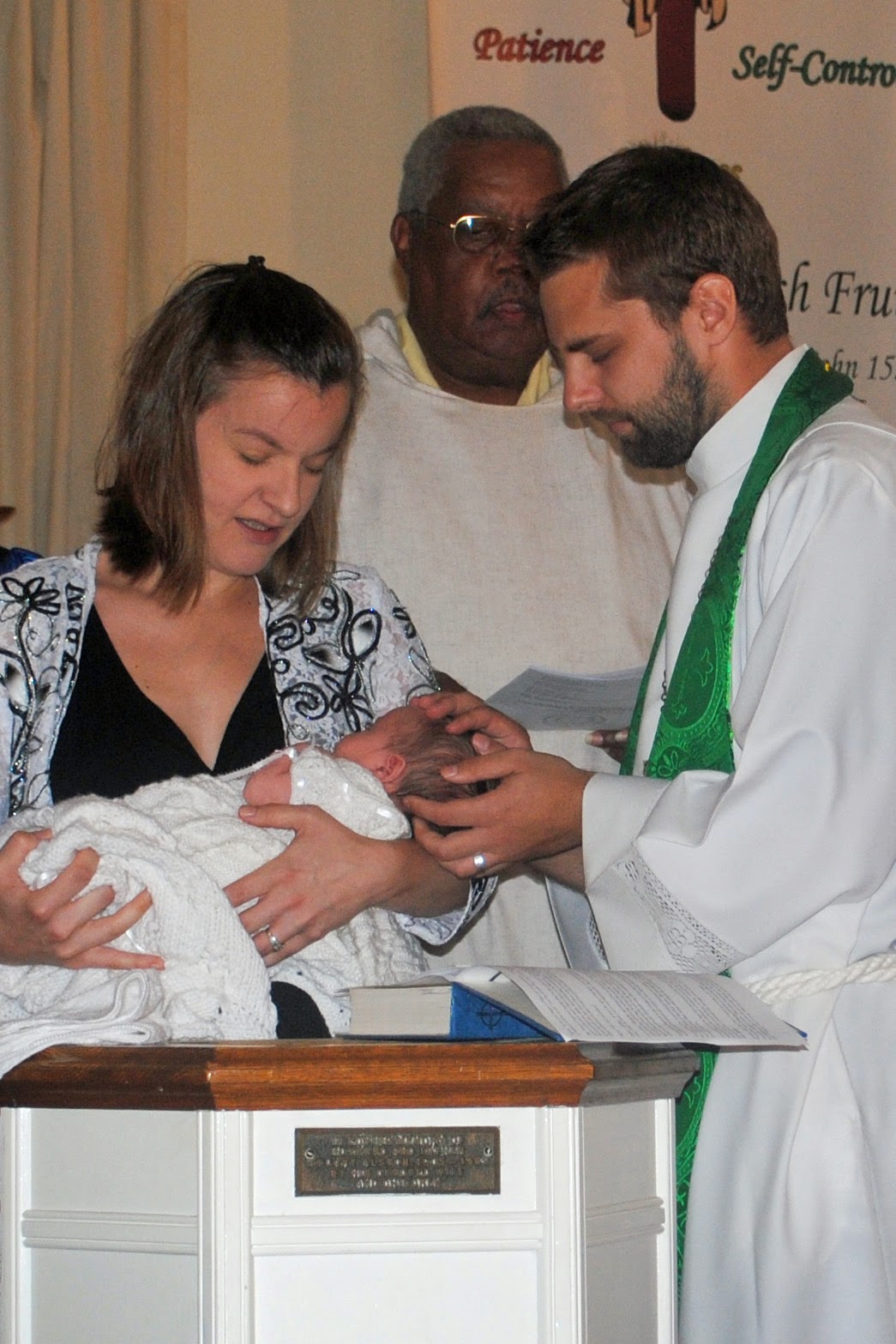
"For to be baptized in the name of God is to be baptized not by men, but by God Himself. Therefore, although it is performed by human hands, it is nevertheless truly God's own work."
Good stuff.
Enough said.
Tuesday, November 11, 2014
Large Catechism: The Lord's Prayer, Seventh Petition
Read the Large Catechism with me.
Ten-minute studies on short readings from the Large Catechism.
Let's do this.
Click on the link below and read the short assigned reading. Then, if you have time, check out what I have to say about it. If not, no problem. Just soak up the goodness of the LC.
The Lord's Prayer, Seventh Petition: Click here and read 112-124.
The basics:
- But deliver us from evil. Amen.
- In the Greek text this petition reads - Deliver or preserve us from the Evil One, or the Malicious One [the devil, himself].
- This petition includes any evil that may happen to us under the devil's kingdom - poverty, shame, death, and all misery and heartache.
- The devil is a liar and a murderer. He constantly seeks our life and wreaks his anger whenever he can afflict our bodies with harm. Hence he often breaks men's necks or drives them to insanity, drowns some, and incites many to commit suicide, and to many other terrible calamities.
- This petition is last; for if we are to be preserved and delivered from all evil, the name of God must first be hallowed in us, His kingdom must be with us, and His will be done.
- This prayer depends upon us learning to say Amen, that is, that we do not doubt that our prayer is surely heard, and shall be done.
- Some believe God does not hear them because of their own sinfulness. They are not regarding the promise of God, but their own work and worthiness; whereby they despise God and will receive nothing.
My thoughts today:
I couldn't help but think about the recent news stories of assisted suicide and the so-called "death with dignity" campaign when reading this.
"For since the devil is not only a liar, but also a murderer, he constantly seeks our life, and wreaks his anger whenever he can afflict our bodies with misfortune and harm. Hence it comes that he often breaks men's necks or drives them to insanity, drowns some, and incites many to commit suicide, and to many other terrible calamities."
Damn the devil. Seriously. And good thing we already know he is, but damn him more for bringing down so many with him.
Suicide is such a terrible terrible loss for all those seeking answers back here. The devil convinces people it is their only choice, and then he convinces the ones left here that they weren't enough for their loved one.
Damn the devil.
Please watch the video below, and stand with Maggie for life. Let us look the devil in the face and call him what he is - LIAR! MURDERER! When he tries to convince us that he has a better way, may God strengthen us and help us stand firm in His promises.
To life!
And may God deliver us all from the evil one. Amen.
Ten-minute studies on short readings from the Large Catechism.
Let's do this.
Click on the link below and read the short assigned reading. Then, if you have time, check out what I have to say about it. If not, no problem. Just soak up the goodness of the LC.
The Lord's Prayer, Seventh Petition: Click here and read 112-124.
The basics:
- But deliver us from evil. Amen.
- In the Greek text this petition reads - Deliver or preserve us from the Evil One, or the Malicious One [the devil, himself].
- This petition includes any evil that may happen to us under the devil's kingdom - poverty, shame, death, and all misery and heartache.
- The devil is a liar and a murderer. He constantly seeks our life and wreaks his anger whenever he can afflict our bodies with harm. Hence he often breaks men's necks or drives them to insanity, drowns some, and incites many to commit suicide, and to many other terrible calamities.
- This petition is last; for if we are to be preserved and delivered from all evil, the name of God must first be hallowed in us, His kingdom must be with us, and His will be done.
- This prayer depends upon us learning to say Amen, that is, that we do not doubt that our prayer is surely heard, and shall be done.
- Some believe God does not hear them because of their own sinfulness. They are not regarding the promise of God, but their own work and worthiness; whereby they despise God and will receive nothing.
My thoughts today:
I couldn't help but think about the recent news stories of assisted suicide and the so-called "death with dignity" campaign when reading this.
"For since the devil is not only a liar, but also a murderer, he constantly seeks our life, and wreaks his anger whenever he can afflict our bodies with misfortune and harm. Hence it comes that he often breaks men's necks or drives them to insanity, drowns some, and incites many to commit suicide, and to many other terrible calamities."
Damn the devil. Seriously. And good thing we already know he is, but damn him more for bringing down so many with him.
Suicide is such a terrible terrible loss for all those seeking answers back here. The devil convinces people it is their only choice, and then he convinces the ones left here that they weren't enough for their loved one.
Damn the devil.
Please watch the video below, and stand with Maggie for life. Let us look the devil in the face and call him what he is - LIAR! MURDERER! When he tries to convince us that he has a better way, may God strengthen us and help us stand firm in His promises.
To life!
And may God deliver us all from the evil one. Amen.
Monday, November 10, 2014
Large Catechism: The Lord's Prayer, Sixth Petition
Read the Large Catechism with me.
Ten-minute studies on short readings from the Large Catechism.
Let's do this.
Click on the link below and read the short assigned reading. Then, if you have time, check out what I have to say about it. If not, no problem. Just soak up the goodness of the LC.
The Lord's Prayer, Sixth Petition: Click here and read 99-111.
The basics:
- And lead us not into temptation.
- Although we have received forgiveness and a good conscience and are entirely acquitted, yet is our life of such a nature that one stands today and tomorrow falls.
- Temptation is of three kinds: of the flesh, of the world, and of the devil.
- Of the flesh: our old Adam incites in us all manner of evil lusts which cling to us by nature.
- Of the world: the world offends us in word and deed, and impels in us anger and impatience.
- Of the devil: the devil provokes us from all directions, especially in spiritual matters. He induces us to despise and disregard both the Word and works of God, to tear us away from faith, hope, and love, and bring us into misbelief and false security, or to despair, denial of God, blasphemy, and innumerable other shocking things.
- In this life we are moved to cry out and to pray that God would not allow us to become weary and faint and to relapse into sin, shame, and unbelief. Otherwise it is impossible to overcome even the least temptation.
- In this life we must endure and be engulfed in trials, but we pray that we may not fall and be drowned in them.
- To feel temptation is a different thing from consenting or yielding to it. To consent thereto is when we give it the reins and do not resist or pray against it.
- We must all feel temptation, although not all in the same manner, but some in a greater degree and more severely than others.
- Pray - Dear Father, Thou hast bidden me pray; let me not relapse because of temptations. Then you will see that they must desist, and finally acknowledge themselves conquered.
- If we venture to help ourselves by our own thoughts and counsel, we will only make the matter worse and give the devil more space.
My thoughts today:
I cannot talk about anything else before saying that Luther's final words made me want to throw up. I seriously felt sick. I mean, come on, who likes snakes? They are disgusting. I know...I know...some people have snakes as pets, but I don't go to those people's houses, nor do I even pretend to understand them at all.
Yuck.
"For he has a serpent's head, which if it gain an opening into which he can slip, the whole body will follow without check."
Yuck. That puts some seriously disturbing images in my mind. Which I suppose is very fitting, since the devil and his sly ways should put disturbing images in my mind. Well played, Luther.
Because of our flesh, because of the world, and because of the devil there are plenty of little holes in our lives, quite large enough for the serpent's head to come through.
And where he can fit his head, he can fit his entire being.
And this is the reason we pray for God to fill those holes - to aid us in blocking the temptations from taking hold of us. For we all must feel the temptation, some with more intensity than others, but the feeling of temptation is far different from the consenting of it.
"For though I am now chaste, patient, kind, and in firm faith, the devil will this very hour send such an arrow into my heart that I can scarcely stand. For he is an enemy that never desists nor becomes tired, so that when one temptation ceases, there always arise others and fresh ones."
Thanks be to God! There is a Man who had no holes for the serpent's head. But because of our holes, He laid down His life in our place. He was pierced, and from that hole sprang blood and water. Blood shed for me and for you. Water used to Baptize us into His death. The blood and water that fills the holes of our temptations.
And because of this, we are able to boldly pray, "And lead us not into temptation."
Ten-minute studies on short readings from the Large Catechism.
Let's do this.
Click on the link below and read the short assigned reading. Then, if you have time, check out what I have to say about it. If not, no problem. Just soak up the goodness of the LC.
The Lord's Prayer, Sixth Petition: Click here and read 99-111.
The basics:
- And lead us not into temptation.
- Although we have received forgiveness and a good conscience and are entirely acquitted, yet is our life of such a nature that one stands today and tomorrow falls.
- Temptation is of three kinds: of the flesh, of the world, and of the devil.
- Of the flesh: our old Adam incites in us all manner of evil lusts which cling to us by nature.
- Of the world: the world offends us in word and deed, and impels in us anger and impatience.
- Of the devil: the devil provokes us from all directions, especially in spiritual matters. He induces us to despise and disregard both the Word and works of God, to tear us away from faith, hope, and love, and bring us into misbelief and false security, or to despair, denial of God, blasphemy, and innumerable other shocking things.
- In this life we are moved to cry out and to pray that God would not allow us to become weary and faint and to relapse into sin, shame, and unbelief. Otherwise it is impossible to overcome even the least temptation.
- In this life we must endure and be engulfed in trials, but we pray that we may not fall and be drowned in them.
- To feel temptation is a different thing from consenting or yielding to it. To consent thereto is when we give it the reins and do not resist or pray against it.
- We must all feel temptation, although not all in the same manner, but some in a greater degree and more severely than others.
- Pray - Dear Father, Thou hast bidden me pray; let me not relapse because of temptations. Then you will see that they must desist, and finally acknowledge themselves conquered.
- If we venture to help ourselves by our own thoughts and counsel, we will only make the matter worse and give the devil more space.
My thoughts today:
I cannot talk about anything else before saying that Luther's final words made me want to throw up. I seriously felt sick. I mean, come on, who likes snakes? They are disgusting. I know...I know...some people have snakes as pets, but I don't go to those people's houses, nor do I even pretend to understand them at all.
Yuck.
"For he has a serpent's head, which if it gain an opening into which he can slip, the whole body will follow without check."
Yuck. That puts some seriously disturbing images in my mind. Which I suppose is very fitting, since the devil and his sly ways should put disturbing images in my mind. Well played, Luther.
Because of our flesh, because of the world, and because of the devil there are plenty of little holes in our lives, quite large enough for the serpent's head to come through.
And where he can fit his head, he can fit his entire being.
And this is the reason we pray for God to fill those holes - to aid us in blocking the temptations from taking hold of us. For we all must feel the temptation, some with more intensity than others, but the feeling of temptation is far different from the consenting of it.
"For though I am now chaste, patient, kind, and in firm faith, the devil will this very hour send such an arrow into my heart that I can scarcely stand. For he is an enemy that never desists nor becomes tired, so that when one temptation ceases, there always arise others and fresh ones."
Thanks be to God! There is a Man who had no holes for the serpent's head. But because of our holes, He laid down His life in our place. He was pierced, and from that hole sprang blood and water. Blood shed for me and for you. Water used to Baptize us into His death. The blood and water that fills the holes of our temptations.
And because of this, we are able to boldly pray, "And lead us not into temptation."
Friday, November 7, 2014
Large Catechism: The Lord's Prayer, Fifth Petition
Read the Large Catechism with me.
Ten-minute studies on short readings from the Large Catechism.
Let's do this.
Click on the link below and read the short assigned reading. Then, if you have time, check out what I have to say about it. If not, no problem. Just soak up the goodness of the LC.
The Lord's Prayer, Fifth Petition: Click here and read 85-98.
The basics:
- And forgive us our trespasses, as we forgive those who trespass against us.
- This petition relates to our poor miserable life, which, although we have and believe the Word of God, and submit to His will, and are supported by His gifts, is nevertheless not without sin.
- He forgives our sins even without our prayer, because He gives us the Gospel, which is nothing but total forgiveness.
- Because we are sinful, it is ceaselessly necessary that we obtain consolation to comfort our conscience.
- This prayer keeps us humble. Anyone who boasts of his godliness must consider himself and place this prayer before his eyes, and he will find that he is no better than others, and that in the presence of God, all must be humbled, and be glad that they can attain forgiveness.
- Confident prayers and a joyful heart spring from nothing else than the certain knowledge of the forgiveness of sins.
- Just as we daily sin against God, and yet He forgives everything through grace, so we, too, must ever forgive our neighbor who does us injury, violence, and wrong.
- "Dear Father, for this reason I come and pray Thee to forgive me, not that I can make satisfaction, or can merit anything by my works, but because Thou hast promised and attached the seal thereto that I should be as sure as though I had absolution pronounced by Thyself."
My thoughts today:
I have always been a pretty deep theological thinker. Not that I knew very much, but I always had questions. I distinctly remember questioning forgiveness as I was growing up. I remember many conversations with my mom based around this question -
Young Kelly: OK, so I ask for forgiveness and God forgives me.,.then, I tell a lie, step off the curb, and get killed by a car. What happens then?
I really struggled with this concept, because I was raised in a holiness movement church. I knew my biggest responsibility was to avoid sinning. And although there are a lot of Lutherans out there that would shudder at what I am about to say, the truth is, we should be trying to avoid sin. I should make that a priority in my life. Will I be able to succeed? No, of course not. Luther says in this reading, "...we have Satan at our back, who sets upon us on every side, and fights (as we have heard) against all the foregoing petitions, so that it is not possible always to stand firm in such a persistent conflict."
But nevertheless, I keep fighting sin with the help of God.
The conscience is Satan's playground, though, and that is why teaching that we are able to live a holy life is so very dangerous. When we inevitably fall to the persistent conflict, we become unsure of our salvation. When that car hits us on the road before we were able to get in that last confession, we don't know where we will be headed. We become a walking target for Satan to attack our stumbles, and convince our conscience that we have not earned God's mercy.
So, we teach that we are poor miserable sinners, needing daily repentance, and that our sufficiency is found in Christ. His ceaseless prayers on our behalf cover our stumbles, and we can finally feel free in the Gospel. No action of mine can earn my ticket to heaven. It has been purchased for me with the Blood of the Lamb. And that ticket is as sure as God Himself.
Ten-minute studies on short readings from the Large Catechism.
Let's do this.
Click on the link below and read the short assigned reading. Then, if you have time, check out what I have to say about it. If not, no problem. Just soak up the goodness of the LC.
The Lord's Prayer, Fifth Petition: Click here and read 85-98.
The basics:
- And forgive us our trespasses, as we forgive those who trespass against us.
- This petition relates to our poor miserable life, which, although we have and believe the Word of God, and submit to His will, and are supported by His gifts, is nevertheless not without sin.
- He forgives our sins even without our prayer, because He gives us the Gospel, which is nothing but total forgiveness.
- Because we are sinful, it is ceaselessly necessary that we obtain consolation to comfort our conscience.
- This prayer keeps us humble. Anyone who boasts of his godliness must consider himself and place this prayer before his eyes, and he will find that he is no better than others, and that in the presence of God, all must be humbled, and be glad that they can attain forgiveness.
- Confident prayers and a joyful heart spring from nothing else than the certain knowledge of the forgiveness of sins.
- Just as we daily sin against God, and yet He forgives everything through grace, so we, too, must ever forgive our neighbor who does us injury, violence, and wrong.
- "Dear Father, for this reason I come and pray Thee to forgive me, not that I can make satisfaction, or can merit anything by my works, but because Thou hast promised and attached the seal thereto that I should be as sure as though I had absolution pronounced by Thyself."
My thoughts today:
I have always been a pretty deep theological thinker. Not that I knew very much, but I always had questions. I distinctly remember questioning forgiveness as I was growing up. I remember many conversations with my mom based around this question -
Young Kelly: OK, so I ask for forgiveness and God forgives me.,.then, I tell a lie, step off the curb, and get killed by a car. What happens then?
I really struggled with this concept, because I was raised in a holiness movement church. I knew my biggest responsibility was to avoid sinning. And although there are a lot of Lutherans out there that would shudder at what I am about to say, the truth is, we should be trying to avoid sin. I should make that a priority in my life. Will I be able to succeed? No, of course not. Luther says in this reading, "...we have Satan at our back, who sets upon us on every side, and fights (as we have heard) against all the foregoing petitions, so that it is not possible always to stand firm in such a persistent conflict."
But nevertheless, I keep fighting sin with the help of God.
The conscience is Satan's playground, though, and that is why teaching that we are able to live a holy life is so very dangerous. When we inevitably fall to the persistent conflict, we become unsure of our salvation. When that car hits us on the road before we were able to get in that last confession, we don't know where we will be headed. We become a walking target for Satan to attack our stumbles, and convince our conscience that we have not earned God's mercy.
So, we teach that we are poor miserable sinners, needing daily repentance, and that our sufficiency is found in Christ. His ceaseless prayers on our behalf cover our stumbles, and we can finally feel free in the Gospel. No action of mine can earn my ticket to heaven. It has been purchased for me with the Blood of the Lamb. And that ticket is as sure as God Himself.
Thursday, November 6, 2014
Large Catechism: The Lord's Prayer, Fourth Petition
Read the Large Catechism with me.
Ten-minute studies on short readings from the Large Catechism.
Let's do this.
Click on the link below and read the short assigned reading. Then, if you have time, check out what I have to say about it. If not, no problem. Just soak up the goodness of the LC.
The Lord's Prayer, Fourth Petition: Click here and read 71-84.
The basics:
- Give us this day our daily bread.
- In this prayer, we consider the necessities of the body and the temporal life.
- We are not simply praying for our own shelves to be stocked with food, but for the distant field and entire land to be fruitful. If God did not cause it to grow, we could never take bread from the oven.
- There is a great need to pray for temporal authority and government, because although we have received of God all good things in abundance, we are not able to retain them in security or happiness if He did not give us a permanent and peaceful government.
- Those in the government are worthy of all honor, that we give to them for their office, because through them we enjoy what we have in peace in quietness. We also pray for them that through them God may bestow on us more blessing and good.
- Luther gives a list of some of the things included when we pray for daily bread: food, drink, clothing, house, home, health of body, the grain and fruits of the field to grow and mature well, good housekeeping, the gift of godly spouses, children, and servants, that our trade or work be successful, faithful neighbors, good friends, wisdom and strength to all those in government roles, and obedience and peace to all subjects under the government; also that He preserve us from all calamity, as in lightning, hail, fire, flood, poison, pestilence, cattle-plague, war and bloodshed, famine, destructive beasts, and wicked men.
- All good things come from God, and must be prayed for by us.
- This prayer is also against the devil, because he wishes for no man to have even a morsel of bread or a moment of peace.
- Although God abundantly grants all these good things even to the wicked, He wishes we pray for them, in order that we may recognize we receive them from His hand, and may feel His paternal goodness toward us.
My thoughts today:
I am really glad God doesn't expect me to say the never-ending list of daily bread every time I pray the Lord's Prayer! I would never have a moment to even enjoy one of them, and the reason is because He is such a gracious giver of our temporal needs.
Sometimes when my husband prays before a meal, he will pray for the food and then pray for all who had a hand in preparing it. So, if we are having chicken, he prays in thanksgiving for me for cooking it, the store workers for stocking it, the truck drivers for taking it to the store, the chicken farmers for raising it, the grain farmers for growing the seeds to feed it, and God for making all this possible. The first time I ever heard my husband pray this way, I was amazed. I guess I never really thought about all the people who bless me with what I have. God uses people throughout the world to put that chicken on my table. Thanks be to God!
The same is true for this prayer - give us this day our daily bread. In praying these words that He gave us to represent all this, we are praying for an endless list of people and vocations. In His honoring of this prayer, He blesses me with a chicken and He blesses so many others with a job and way of life.
We really are a sorry lot of prayers. We tire easily, we forget easily, and we fail to see the gifts God is giving us each day. Thanks be to God that He knows we need these words to pray. That when I say, "Give us this day our daily bread," I am praying for more than I could ever even think of on my own.
Ten-minute studies on short readings from the Large Catechism.
Let's do this.
Click on the link below and read the short assigned reading. Then, if you have time, check out what I have to say about it. If not, no problem. Just soak up the goodness of the LC.
The Lord's Prayer, Fourth Petition: Click here and read 71-84.
The basics:
- Give us this day our daily bread.
- In this prayer, we consider the necessities of the body and the temporal life.
- We are not simply praying for our own shelves to be stocked with food, but for the distant field and entire land to be fruitful. If God did not cause it to grow, we could never take bread from the oven.
- There is a great need to pray for temporal authority and government, because although we have received of God all good things in abundance, we are not able to retain them in security or happiness if He did not give us a permanent and peaceful government.
- Those in the government are worthy of all honor, that we give to them for their office, because through them we enjoy what we have in peace in quietness. We also pray for them that through them God may bestow on us more blessing and good.
- Luther gives a list of some of the things included when we pray for daily bread: food, drink, clothing, house, home, health of body, the grain and fruits of the field to grow and mature well, good housekeeping, the gift of godly spouses, children, and servants, that our trade or work be successful, faithful neighbors, good friends, wisdom and strength to all those in government roles, and obedience and peace to all subjects under the government; also that He preserve us from all calamity, as in lightning, hail, fire, flood, poison, pestilence, cattle-plague, war and bloodshed, famine, destructive beasts, and wicked men.
- All good things come from God, and must be prayed for by us.
- This prayer is also against the devil, because he wishes for no man to have even a morsel of bread or a moment of peace.
- Although God abundantly grants all these good things even to the wicked, He wishes we pray for them, in order that we may recognize we receive them from His hand, and may feel His paternal goodness toward us.
My thoughts today:
I am really glad God doesn't expect me to say the never-ending list of daily bread every time I pray the Lord's Prayer! I would never have a moment to even enjoy one of them, and the reason is because He is such a gracious giver of our temporal needs.
Sometimes when my husband prays before a meal, he will pray for the food and then pray for all who had a hand in preparing it. So, if we are having chicken, he prays in thanksgiving for me for cooking it, the store workers for stocking it, the truck drivers for taking it to the store, the chicken farmers for raising it, the grain farmers for growing the seeds to feed it, and God for making all this possible. The first time I ever heard my husband pray this way, I was amazed. I guess I never really thought about all the people who bless me with what I have. God uses people throughout the world to put that chicken on my table. Thanks be to God!
The same is true for this prayer - give us this day our daily bread. In praying these words that He gave us to represent all this, we are praying for an endless list of people and vocations. In His honoring of this prayer, He blesses me with a chicken and He blesses so many others with a job and way of life.
We really are a sorry lot of prayers. We tire easily, we forget easily, and we fail to see the gifts God is giving us each day. Thanks be to God that He knows we need these words to pray. That when I say, "Give us this day our daily bread," I am praying for more than I could ever even think of on my own.
Subscribe to:
Posts (Atom)